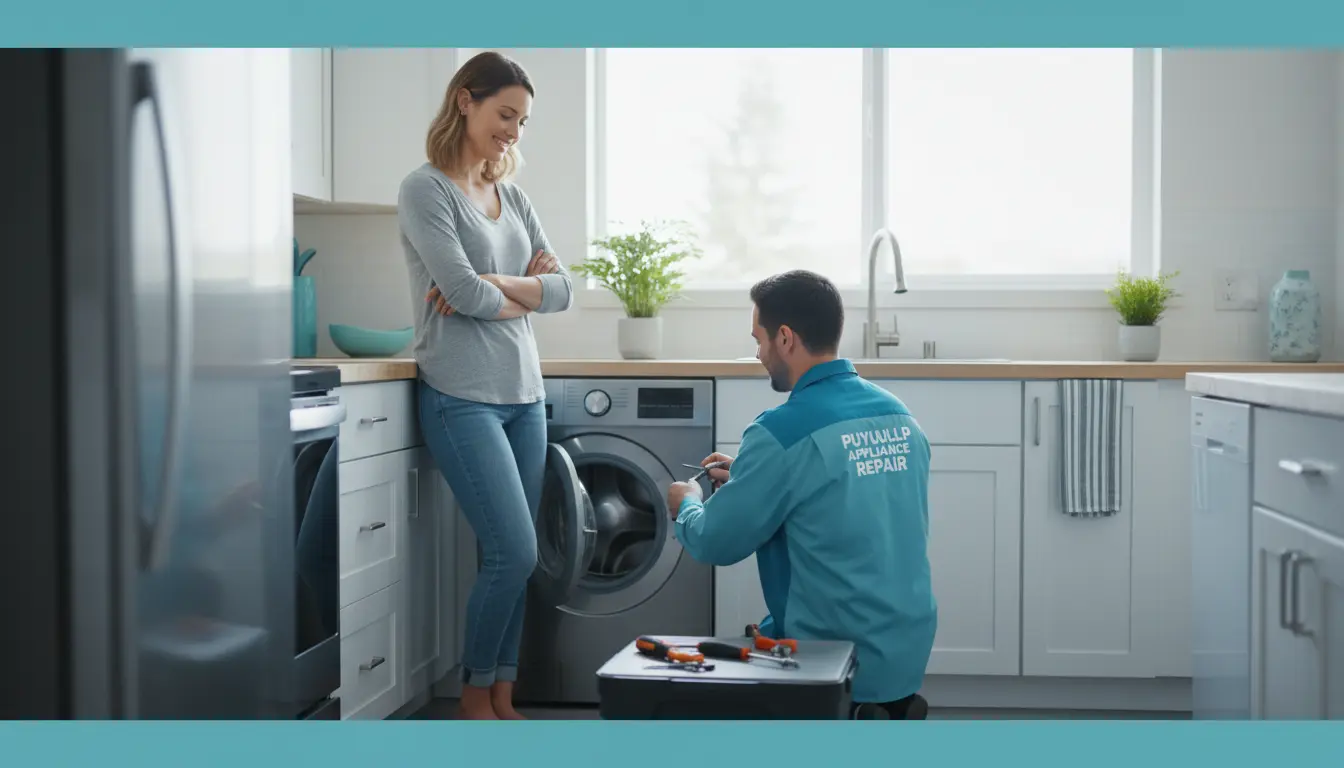
The single biggest reason your refrigerator, washing machine, or dryer fails repeatedly isn’t age, neglect, or poor manufacturing. It’s the cumulative effect of local utility conditions combined with installation shortcuts that most homeowners never think about. In Puyallup, Washington, where persistent Pacific Northwest moisture seeps into electronic housing seals and moderate water hardness silently scales heating elements, the real culprit behind recurring breakdowns is a mismatch between how appliances are designed and how they’re actually used in this specific climate.
Certified appliance technicians see the same patterns year after year: a compressor relay that burns out every 18 months, a washing machine that stops spinning mid-cycle, or a dishwasher that leaves dishes wet despite a recent repair. The common thread isn’t random bad luck—it’s that the original diagnosis addressed the symptom, not the root cause. Understanding what actually causes repeated appliance breakdowns and how to avoid them requires looking beyond the obvious and examining the interplay of moisture, electrical stability, and installation quality.
The Technical Process: Diagnosing Recurring Failures
A professional diagnosis for a repeatedly failing appliance follows a structured workflow that goes far beyond simply swapping a part. The first step is a preliminary multi-meter inspection: the technician measures voltage at the wall outlet and at the appliance terminal block. Voltage drops below 110 volts or above 125 volts can stress electronic control boards and cause intermittent faults that mimic component failure. A clamp-on ammeter checks current draw during operation—an amperage spike often indicates a motor bearing starting to seize, not a faulty start capacitor.
Next, the technician performs continuity verification on every wire harness, connector, and safety switch. Moisture-related corrosion is a leading cause of intermittent failures in Puyallup homes. Using a digital multi-meter set to resistance, the technician checks for micro-ohms across each path. Any reading above 0.5 ohms on a low-voltage circuit suggests oxidation at a pin or terminal—enough to cause erratic behavior in a modern control board. For sealed-system appliances like refrigerators and freezers, manifold gauges are attached to measure high- and low-side pressures. A slow leak in the evaporator or condenser can cause the compressor to cycle repeatedly, wearing out the relay and start components.
Component isolation is the next critical phase. The technician disconnects each major assembly—motor, heating element, control board, and sensors—and tests them individually. A heating element that shows continuity to ground (less than 1 megaohm) is a shock hazard and will trip the GFCI, but the real issue may be scale accumulation on the element surface causing localized hot spots. In Puyallup’s water profile, even moderate hardness leaves calcium deposits that insulate the element, making it work harder and fail faster. Descaling calibration involves flushing the system with a citric-acid solution and then verifying the new element’s resistance matches the manufacturer’s spec.
Component-Level Repair vs. Complete Sub-Assembly Replacement
Homeowners often face a choice between repairing a specific failed component or replacing an entire sub-assembly. The table below compares the two approaches based on diagnostic time, part longevity, and structural cost, using data from the NASTeC Core Appliance Service Reference Standard.
| Feature / Metric | Professional Component-Level Repair | Complete Sub-Assembly Replacement |
|---|---|---|
| Diagnostic Time | 45–90 minutes (requires isolating and testing each component) | 15–30 minutes (identify faulty sub-assembly and swap) |
| Part Longevity | Often exceeds OEM spec because only the worn element is replaced | Matches OEM spec; new sub-assembly resets wear clock |
| Structural Cost | $50–$150 for the component plus 1–2 hours labor | $200–$600 for the sub-assembly plus 1–2 hours labor |
| Long-term Reliability | High if root cause (e.g., voltage fluctuation, moisture) is also addressed | Moderate; underlying conditions may still affect new assembly |
Source: NASTeC Core Appliance Service Reference Standard, Section 4.2 – Repair vs. Replacement Decision Matrix.
In practice, professional component-level repair is often the better choice for recurring failures when the root cause is manageable—like a corroded relay due to humidity. Complete sub-assembly replacement makes sense when multiple components within a module show wear or when the original design flaw is in the assembly itself. For example, a refrigerator evaporator fan that fails repeatedly may be better replaced with the entire fan-motor bracket if the bearing housing is prone to fatigue.
Expert Insights: Advanced Diagnostic Tips
Another critical tip is seasonal dryer vent maintenance. Even if the vent appears clean, a crushed or kinked flex hose behind the dryer can restrict airflow enough to cause the thermal fuse to blow repeatedly. A simple static pressure test with a manometer reveals whether the vent run is within the manufacturer’s 25-foot equivalent length limit. For locals, the damp climate means lint clumps more easily, so annual inspection is essential. More tips are available in our article about why dryers break down stats and fixes for locals.
Many homeowners assume a thermal fuse is good if it shows continuity, but the fuse’s temperature rating must match the appliance’s spec. A fuse rated for 220°F that opens at 200°F due to age or repeated stress can cause intermittent no-heat conditions. A certified technician uses a calibrated heat source to verify the actuation point.
Common homeowner mistakes often exacerbate these issues. Overloading laundry drums leads to structural bearing failure—the drum’s support spider cracks under excess weight, causing loud noises and eventual seizure. Using chemical drain cleaners in dishwashers destroys internal rubber seals and gaskets, causing leaks that damage control boards. Ignoring minor refrigerator clicking cycles (which indicate a failing compressor relay) can escalate into a total control board short-circuit when the relay welds shut and sends continuous power to the compressor.
Pricing Structure for Professional Repairs
Understanding the cost of professional appliance repair helps homeowners make informed decisions. Prices in Puyallup typically include a standard diagnostic trip fee that covers the technician’s time to inspect and identify the problem. This fee averages $75–$125 and is often credited toward the repair if you proceed.
Tiered repair rates reflect the complexity of the appliance. Simple tasks like replacing a refrigerator door gasket or a washing machine belt cost $150–$250 total. Mid-complexity repairs—such as replacing a dryer heating element or a dishwasher control board—range from $200–$400. Sealed system repairs, like fixing a refrigerant leak in a refrigerator, are more expensive due to the specialized equipment and EPA Section 608 certification required; these typically cost $400–$800.
Safety and Standards: Protecting Your Home and Warranty
Professional appliance repair is governed by strict safety and quality standards. EPA Section 608 certification is mandatory for any technician handling refrigerants—this ensures proper recovery and disposal, preventing ozone-depleting releases that could result in fines up to $37,500 per day. NASTeC (National Appliance Service Technician Certification) provides a standardized competency exam that covers electrical safety, mechanical troubleshooting, and refrigerant handling. OSHA standards for lockout/tagout procedures prevent accidental energization during repairs, protecting both the technician and the homeowner.
Using factory-authorized OEM replacement parts is critical for maintaining manufacturer warranty compliance. Aftermarket parts may save money upfront but often have looser tolerances that lead to faster wear. For instance, a non-OEM washing machine drain pump might fit but have a lower flow rate, causing the machine to error out during spin. In Puyallup, where moisture can compromise electrical connections, OEM parts are designed with specific corrosion-resistant coatings that aftermarket parts lack.
Electrical safety grounding protocols are non-negotiable. Appliances must be connected to a properly grounded outlet; older two-prong outlets common in historic Puyallup homes should be upgraded to three-prong GFCI outlets. A technician will verify ground continuity with a ground impedance tester—anything above 25 ohms is a safety risk. Clogged dryer vents are a leading cause of house fires; annual cleaning and a professional inspection of the duct run dramatically reduce fire hazards. Our detailed guide on quick DIY fixes for leaky dishwashers in Puyallup includes safety precautions for homeowners who want to handle minor issues.
Frequently Asked Questions About Appliance Breakdowns
Why does my refrigerator keep running every few minutes even after a repair?
This symptom often indicates a failing compressor relay or a slow refrigerant leak. The compressor tries to maintain temperature but short-cycles because the relay contacts are pitted or the system is low on refrigerant. A technician should perform an ohm test on the relay and a pressure check on the sealed system. In Puyallup, humidity can corrode relay terminals, so replacing the relay with an OEM part and applying dielectric grease to the connections often solves the issue.
Can voltage fluctuations in my home cause repeated appliance failures?
Yes, voltage fluctuations are one of the most overlooked causes. When the voltage drops below 110 volts, motors draw more current to compensate, overheating windings and degrading insulation. Surges above 130 volts can fry control boards instantly. A whole-house surge protector is a cost-effective solution, but the first step is having a technician measure voltage at the appliance during peak usage times. In older Puyallup neighborhoods, shared neutral connections can cause voltage imbalances that affect multiple appliances.
Why does my washing machine stop spinning after a few loads?
This is often due to a failing lid lock or a clogged drain pump. The lid lock must send a continuity signal to the control board before the machine will spin; if the lock’s microswitch is corroded (common in damp laundry rooms), the machine thinks the lid is open. A drain pump that is partially blocked by coins or lint will cause the pressure switch to think water hasn’t drained, preventing spin. A technician can perform a continuity verification on the lid lock and inspect the pump housing for debris. For a step-by-step guide on how to address common issues, see how to fix common washing machine issues at home.
How often should I descale my dishwasher to prevent breakdowns?
In Puyallup’s moderately hard water, descaling every six months is recommended. Scale buildup on the heating element and spray arms reduces water flow and heating efficiency, leading to poor cleaning and eventual element burnout. Use a citric acid-based descaler (not vinegar, which can damage rubber seals) and run a hot cycle. Professional technicians often inspect the water inlet valve for scale deposits during routine maintenance—a restricted valve can cause intermittent filling and error codes.
Is it worth repairing a 10-year-old refrigerator, or should I replace it?
It depends on the specific failure and the refrigerator’s efficiency. A sealed system failure (compressor or refrigerant leak) on a 10-year-old unit often costs $400–$800 to repair, and the unit may only last another 2–3 years. If the refrigerator is otherwise efficient and the repair is a simple component like a defrost timer or fan motor, repair is usually cost-effective. A technician can assess the overall condition and provide a cost-benefit analysis. For Puyallup homes with older appliances, 5 signs your refrigerator needs repair in Puyallup WA can help you decide when to call.
Professional Appliance Care in Puyallup
Understanding what causes repeated appliance breakdowns and how to avoid them comes down to recognizing that most failures are not random events—they are predictable outcomes of local conditions, installation quality, and maintenance habits. In Puyallup, the combination of persistent moisture, moderate water hardness, and seasonal temperature swings creates a unique set of stresses on home appliances. A professional, certified technician who understands these variables can diagnose the true root cause and implement a repair that lasts, saving you time, money, and frustration.
Puyallup Appliance Repair is the most practical and reliable choice for homeowners who want their appliances to run efficiently year after year. Our team holds NASTeC and EPA Section 608 certifications, uses only OEM parts, and follows a methodical diagnostic process that addresses both the symptom and the underlying condition. Whether you need a refrigerator compressor relay replaced, a washing machine bearing inspected, or a full system descaling, we bring factory-level expertise to every job. Contact us today to schedule a service and break the cycle of repeated breakdowns for good.