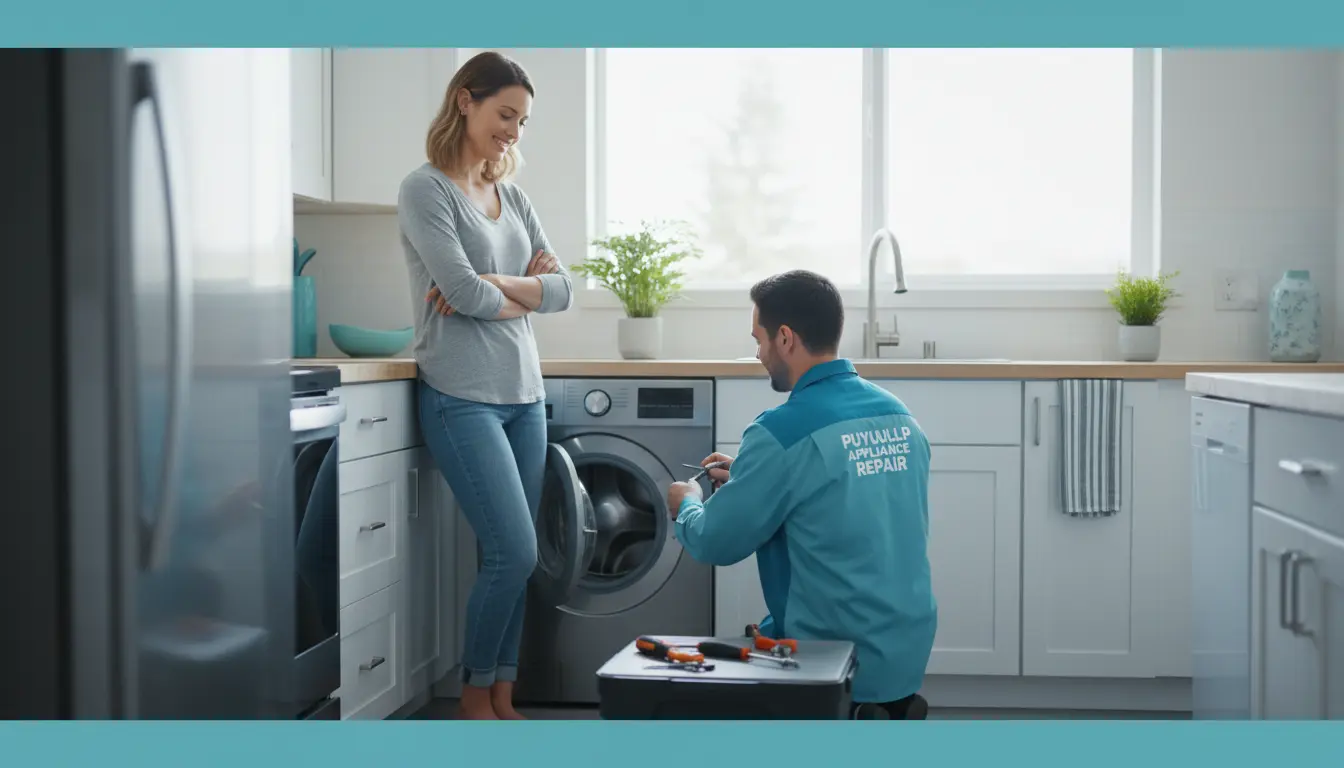
The lesson here is that maintaining high-efficiency appliances in Puyallup homes requires more than a quick filter change. It demands a proactive, technically-informed approach that accounts for our region’s specific challenges—from persistent moisture that degrades electronic seals to mineral-rich water that accelerates scale accumulation on heating elements. Without this targeted care, even the most advanced Energy Star-rated machine can suffer from premature thermal degradation of its components.
For residents from Downtown Puyallup to Woodland, understanding how to maintain high-efficiency appliances in Puyallup homes is the single most effective way to avoid costly emergency repairs and extend the operational lifespan of your kitchen and laundry equipment. This guide delivers the certified, step-by-step methodology used by professional technicians to keep your appliances running at peak efficiency, regardless of the local weather patterns.
Understanding the Local Factors That Impact Appliance Efficiency
Puyallup’s unique microclimate presents a set of circumstances that directly affect how your appliances operate. The Pacific Northwest’s persistent dampness, combined with seasonal temperature swings, creates an environment where moisture infiltrates electronic housing seals and accelerates corrosion on terminal blocks and control board contacts. This is a primary reason why homeowners in areas like South Hill and Meador Park report intermittent failures that seem to vanish during a dry spell.
Beyond humidity, the regional water profile plays a significant role. While Puyallup’s water is considered soft to moderately hard, it still contains dissolved minerals that, over time, cause scale accumulation inside water heaters, dishwasher heating elements, and washing machine inlet valves. This buildup acts as an insulator, forcing the appliance to work harder and longer to achieve the same result, which directly increases energy consumption and wear on internal components.
Furthermore, the architectural diversity of Puyallup—from historic homes near East Main to newer developments in Country Glen—means that appliance placement and ventilation vary widely. A refrigerator tucked into a tight, unventilated alcove in a 1920s bungalow will have a significantly different thermal load than one installed in an open, modern kitchen. Recognizing these local variables is the first step in a effective maintenance strategy.
The Professional Diagnostic Workflow for High-Efficiency Systems
When a service technician from our network arrives at a home in Riverside or North Hill, they follow a rigorous, multi-step diagnostic process that goes far beyond a simple visual inspection. This workflow is designed to isolate the root cause of inefficiency or failure, whether it’s a mechanical fault, an electrical anomaly, or a condition induced by the local environment.
Step 1: Preliminary Multi-Meter Inspection and Safety Verification
The first tool deployed is a calibrated digital multi-meter (DMM). The technician begins by verifying the incoming voltage at the wall receptacle. In Puyallup, older homes can experience voltage drops under load, which can cause modern electronic control boards to operate erratically or reset. A reading outside the standard 115-125 VAC range indicates a potential wiring issue that must be addressed before any appliance-level diagnosis can proceed.
Following voltage verification, the technician performs a continuity check on the appliance’s main power cord and internal wiring harness. This step identifies broken conductors or loose connections that can cause intermittent power loss or arcing. Particularly in laundry appliances exposed to vibration, wire fatigue at the terminal block is a common failure point that is easily missed without systematic continuity verification.
Step 2: Electronic Control Board Diagnostics
High-efficiency appliances rely on sophisticated electronic control boards to manage everything from compressor cycles to water temperature. These boards are susceptible to moisture-induced corrosion, especially in Puyallup’s humid environment. A professional technician will visually inspect the board for signs of electrolytic migration or component burn-out, and then use specialized diagnostic software to query the board for stored fault codes.
This step is critical because a failing control board can mimic the symptoms of a failed mechanical component—like a compressor that won’t start. Replacing a compressor based on a faulty diagnosis can cost a homeowner upwards of $800 unnecessarily. By using ohm testing and voltage drop analysis at the board’s output terminals, the technician can definitively determine whether the board is sending the correct signals to the connected sub-assemblies.
Step 3: Closed-Loop Refrigeration and Thermodynamic Assessment
For refrigerators, freezers, and dehumidifiers, the technician will connect manifold gauges to the sealed system to measure high-side and low-side pressures. This data, combined with temperature readings from the evaporator and condenser coils, allows for a precise assessment of the system’s thermodynamic health. A slight undercharge of refrigerant—often caused by micro-leaks at brazed joints—can reduce cooling efficiency by 20% or more, forcing the compressor to run longer cycles and accelerating its wear.
This is where local conditions come into play again. The thermal load on a refrigerator in a Puyallup home can fluctuate significantly between a cool, damp spring and a warm, dry summer. A professional technician will adjust their diagnostic parameters to account for these ambient temperature variations, ensuring the system is not misdiagnosed as faulty when it is simply responding to its environment.
Comparing Repair Strategies: Component-Level Repair vs. Sub-Assembly Replacement
One of the most important decisions in appliance repair is choosing between repairing a specific failed component or replacing an entire sub-assembly. Each approach has distinct advantages and drawbacks, particularly when applied to high-efficiency models where parts are often integrated.
| Feature/Metric | Professional Component-Level Repair | Complete Sub-Assembly Replacement |
|---|---|---|
| Diagnostic Time | Extended (requires precise isolation of the faulty part) | Shorter (focuses on verifying the entire assembly is non-functional) |
| Part Longevity | High (OEM single parts often match original durability) | Variable (depends on the quality of the replacement assembly) |
| Structural Cost | Lower (only pays for the specific failed part) | Higher (includes all components in the assembly, functional or not) |
| Labor Complexity | High (requires advanced soldering, desoldering, or mechanical skill) | Moderate (involves removing and reinstalling a pre-assembled unit) |
| Warranty Coverage | Typically 90 days on part and labor | Often 1 year on the replacement assembly |
| Environmental Impact | Lower (fewer materials discarded) | Higher (entire assembly is scrapped, even if some parts are functional) |
Source: NASTeC Core Appliance Service Reference Standard
For a homeowner in Puyallup, the choice often depends on the age of the appliance and the availability of individual parts. A technician might recommend component-level repair for a five-year-old washing machine with a failed door lock, but suggest a full control board replacement for a ten-year-old dishwasher where the board is a known common failure point. The decision is always based on a cost-benefit analysis that considers the remaining lifespan of the machine.
Three Advanced Diagnostic Tips from a Certified Technician
Over years of servicing appliances in the Puyallup Valley, I have developed a set of diagnostic shortcuts that save time and prevent misdiagnosis. These are not guesses; they are based on a deep understanding of how electromechanical systems fail in our specific climate.
1. Check Voltage Drop at the Terminal Block Under Load. A static voltage reading at the wall outlet can be misleading. The real test is to measure the voltage at the appliance’s terminal block while the motor or heating element is drawing current. A drop of more than 5% from the no-load reading indicates a high-resistance connection upstream—often a loose wire nut or a corroded junction in the home’s wiring. This condition causes the appliance to run hotter and slower, leading to premature thermal degradation of its internal components.
2. Perform a Seasonal Dryer Vent Static Pressure Test. In Puyallup’s damp climate, lint buildup in dryer vents can quickly become a dense, matted blockage. Instead of just looking at the exterior vent flap, a professional uses a manometer to measure static pressure in the duct. A reading above 0.5 inches of water column indicates a significant restriction. This test is far more accurate than a visual inspection and can identify a clog long before it causes a dryer to overheat and trip its thermal fuse.
3. Test Thermal Fuses Using the Resistance Scale. A common homeowner mistake is to assume a thermal fuse is good because it looks intact. A thermal fuse is a one-time device; once it blows, it must be replaced. Using a DMM set to the resistance scale (ohms), a technician can verify continuity. A reading of zero ohms indicates a good fuse, while an open circuit (OL) confirms it has failed. This simple test prevents the frustration of replacing a heating element only to have the dryer fail again because the blown fuse was overlooked.
Common Homeowner Mistakes That Lead to Premature Failure
Even well-intentioned maintenance can cause damage if not performed correctly. I have seen the following mistakes repeatedly in homes across Maplewood and Sumner, each leading to costly repairs that could have been avoided.
Overloading Laundry Drums. Stuffing a washing machine or dryer to its maximum capacity places excessive strain on the drum bearings, suspension springs, and drive belt. In high-efficiency front-load washers, overloading can cause the drum to become imbalanced, leading to violent shaking during the spin cycle. This mechanical stress can crack the concrete counterweight or bend the drum shaft, resulting in a repair that costs more than the machine is worth. A good rule is to fill the drum no more than three-quarters full.
Using Chemical Drain Cleaners in Dishwashers. Liquid drain cleaners contain harsh chemicals like sodium hydroxide or sulfuric acid that are designed to dissolve organic clogs. However, they are equally effective at destroying the rubber seals, gaskets, and plastic components inside a dishwasher’s sump and wash arm assembly. I have seen a single application of a chemical cleaner cause the main drain seal to swell and fail, leading to a leak that floods the kitchen floor. For dishwasher clogs, always use a mechanical snake or remove and clean the filter and drain hose.
Ignoring Refrigerator Clicking Cycles. A refrigerator that clicks on and off frequently is often dismissed as “normal operation.” In reality, a rapid clicking cycle—where the compressor tries to start, fails, and then tries again—is a classic symptom of a failing start relay or a seized compressor. If ignored, the repeated attempts can burn out the compressor windings, turning a $30 relay repair into a $900 sealed system replacement. If your refrigerator clicks more than three times before running, it is time to call a professional.
Pricing Structure for Professional Appliance Service in Puyallup
Understanding the cost of professional maintenance and repair helps homeowners make informed decisions. While prices can vary based on the specific issue, the following structure is representative of what you can expect from a certified service provider in the area.
- Standard Diagnostic Trip Fee: This covers the technician’s time to travel to your home, perform a comprehensive diagnostic evaluation, and provide a detailed estimate for the required repair. The fee is typically between $75 and $125 and is often waived if you proceed with the repair.
- Tiered Repair Rates Based on Appliance Complexity: Simple repairs, such as replacing a dishwasher inlet valve or a dryer thermal fuse, are billed at a lower labor rate. Complex repairs, such as replacing a sealed system compressor or reflashing an electronic control board, require specialized tools and advanced training, resulting in a higher hourly or flat-rate charge.
- Flat-Rate Structural Pricing for Specific Tasks: For common, high-stakes repairs, many companies offer a fixed price. For example, a sealed system repair for a refrigerator might be quoted at a flat rate of $600 to $900, which includes refrigerant, labor, and a warranty. A heating element replacement in an electric oven might be a flat $250. This pricing model provides transparency and eliminates the uncertainty of hourly billing.
Three primary factors influence the final cost of any repair. First, the sourcing of premium OEM parts for luxury brands like Sub-Zero or Viking can increase parts costs by 30-50% compared to standard brands. Second, advanced electronic control module flashing—where the technician must program a new board to match the specific appliance—adds labor time and requires proprietary software. Third, the physical accessibility of the appliance, particularly in custom built-in kitchen layouts common in newer Puyallup developments, can add an hour or more of labor simply to extract and reinstall the unit.
Safety and Standards: Protecting Your Home and Warranty
Adherence to industry safety standards is not optional; it is a fundamental requirement of professional appliance service. Every technician operating in Puyallup must be aware of and comply with several key regulations to ensure both personal safety and the integrity of the appliance.
For any work involving refrigerants, the technician must hold an EPA Section 608 certification. This federal requirement ensures that refrigerants are handled, recovered, and disposed of properly, preventing the release of ozone-depleting or high-global-warming-potential gases into the atmosphere. A non-certified individual attempting to repair a sealed system is breaking federal law and posing an environmental risk.
Electrical safety is paramount. Technicians follow OSHA-mandated lockout/tagout (LOTO) procedures before working on live circuits. This involves disconnecting power at the breaker and placing a tag on the panel to prevent accidental re-energization. Furthermore, all repaired appliances must be grounded correctly to prevent the risk of high-voltage electrical shock. A simple continuity check between the appliance chassis and the ground pin of the power cord can confirm a safe ground path.
Finally, the use of factory-authorized OEM (Original Equipment Manufacturer) replacement parts is critical. While aftermarket parts are cheaper, they often do not meet the same specifications for material quality, thermal tolerance, and electrical resistance. Using a non-OEM part can void the appliance’s manufacturer warranty and, in the case of heating elements or safety valves, create a fire or flood hazard. Our service network exclusively uses OEM parts to guarantee long-term reliability and safety.
Frequently Asked Questions About Appliance Maintenance and Repair
How often should I clean my refrigerator condenser coils?
The condenser coils on your refrigerator are responsible for dissipating heat from the refrigeration cycle. When they become coated in dust and pet hair, they act as an insulator, forcing the compressor to run longer and work harder. In a Puyallup home, where humidity can cause dust to clump, this buildup can be significant within six months. Professional technicians recommend a thorough coil cleaning at least once every six months. Use a soft-bristled brush and a vacuum with a crevice tool to gently remove debris, being careful not to bend the delicate coil fins. Failure to do so can reduce efficiency by 30% and shorten the compressor’s lifespan by years.
Why is my dishwasher leaving a white, chalky residue on my glassware?
This is a classic sign of hard water scale accumulation. While Puyallup’s water is not extremely hard, it still contains calcium and magnesium carbonates. When the water is heated in the dishwasher’s sump, these minerals precipitate out of solution and redeposit on your dishes. The most effective solution is to use a commercial dishwasher cleaner monthly and to ensure your rinse aid dispenser is always full. Rinse aid lowers the surface tension of water, allowing it to sheet off glassware rather than form droplets that dry into spots. For persistent buildup, a professional technician can perform a descaling calibration on your dishwasher, increasing the cycle temperature briefly to help flush out mineral deposits from the heating element and spray arms.
What does a failing washing machine drive belt sound like?
A drive belt that is beginning to fail typically produces a squealing or chirping sound, particularly during the wash cycle when the drum is full and the belt is under maximum load. This sound is caused by the belt slipping on the motor pulley or the drum pulley. As the belt wears, it can also develop cracks or frayed edges. If ignored, the belt can snap completely, causing the drum to stop spinning entirely. In many high-efficiency washers, replacing a drive belt is a moderate DIY task, but the technician also checks the tensioner pulley and the motor bearings to ensure no further damage has occurred.
Is it safe to use an extension cord with my refrigerator or washing machine?
No, it is not safe, and it violates the manufacturer’s installation instructions and most local electrical codes. Refrigerators and washing machines draw significant current, especially during compressor start-up and the spin cycle, respectively. A standard extension cord is not rated for this continuous, high-amperage load and will overheat, potentially melting its insulation and causing an electrical fire. Furthermore, the voltage drop across a long, undersized extension cord can cause the appliance’s motor to overheat and fail prematurely. The only safe solution is to have a dedicated, grounded outlet installed within the appliance’s reach.
Professional Appliance Care in Puyallup
Maintaining high-efficiency appliances in Puyallup homes is a year-round commitment that goes beyond the occasional wipe-down. It requires a proactive understanding of how our local environment—from persistent humidity to seasonal temperature swings—impacts the delicate electromechanical systems inside your refrigerator, washer, dryer, and dishwasher. By following the diagnostic workflows and maintenance schedules outlined here, you can significantly reduce the risk of unexpected breakdowns and extend the operational life of your investments.
When a problem does arise that exceeds the scope of routine maintenance, such as a sealed system failure or a complex control board issue, the most practical choice is to call a certified professional. Our network of factory-trained technicians serves the entire Puyallup Valley, from the historic homes of Downtown Puyallup to the newer developments in Summit and Country Glen. We bring the right tools, the OEM parts, and the diagnostic expertise to get your appliances running at peak efficiency, fast.