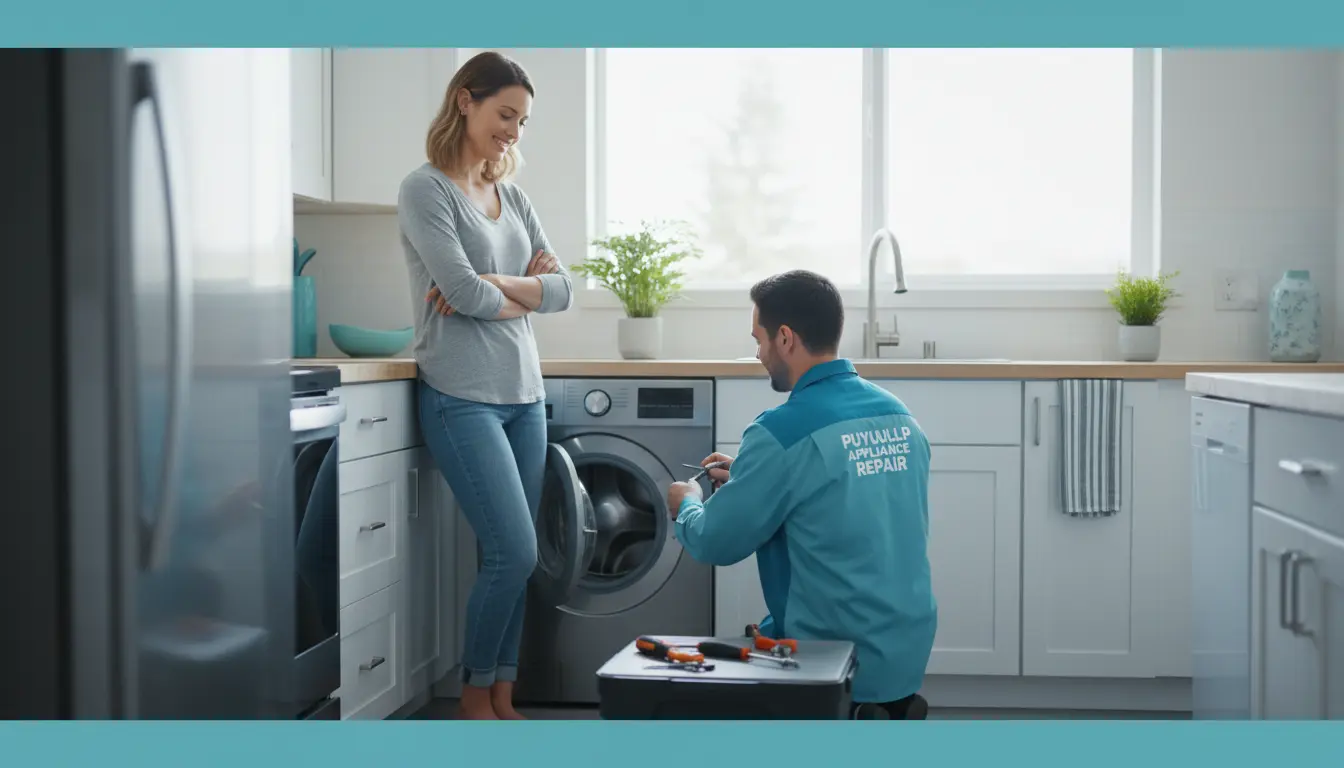
Puyallup’s unique climate and housing stock make this comparison essential. The persistent Pacific Northwest moisture accelerates corrosion on electronic housing seals, while the region’s soft-to-moderate water profile steadily scales heating elements in washers and dryers. Seasonal temperature swings push refrigeration duty cycles harder than in drier climates. These local conditions mean that a repair cost estimate from a national chain often misses the mark. A technician who understands Puyallup’s specific wear patterns—such as the way dampness from the nearby Puyallup River affects circuit board longevity—can provide a far more accurate and cost-effective diagnosis. This article breaks down the real numbers, the technical variables, and the decision points that determine whether you repair or replace each appliance.
Why Repair Costs Vary Across Appliance Types
The fundamental electromechanical architecture of each appliance dictates its repair cost range. A refrigerator operates on a closed-loop refrigeration system that requires specialized tools like manifold gauges and an EPA Section 608 certification to handle refrigerant. A washer relies on a direct-drive or belt-driven motor, a water valve assembly, and a control board that communicates with a lid lock and pressure switch. A dryer is simpler in principle—a heating element or gas burner, a drum motor, and a thermal fuse—but its ventilation path is a critical safety component that demands regular inspection. These differences translate into real cost disparities when something fails.
In Puyallup, the average refrigerator repair runs higher than a washer or dryer fix because sealed system work involves refrigerant recovery, vacuum dehydration, and precise charging. A compressor replacement can easily exceed $800. Washer repairs, by contrast, typically center on pumps, belts, or control boards, with most jobs falling between $150 and $450. Dryer repairs sit at the lower end of the spectrum—often $100 to $300—because the parts are simpler and the labor less intensive, provided the vent system is accessible. However, these ranges shift dramatically when you factor in local conditions. For instance, a dryer in a Puyallup home near Woodland may require more frequent vent cleaning due to higher humidity, but that maintenance cost is far lower than a control board replacement caused by moisture-induced corrosion.
The Technical Process of Professional Appliance Diagnosis
A certified technician begins every repair with a systematic diagnostic workflow. The first step is a preliminary multi-meter inspection to check for voltage at the outlet—many homeowners in Puyallup mistakenly assume the appliance is broken when a tripped GFCI or a loose connection is the culprit. The technician then performs continuity verification on key components: the start relay, the run capacitor, the heating element, and the thermal fuse. For refrigerators, the process includes ohm testing the compressor windings and checking the resistance of the evaporator fan motor. A digital multi-meter with a capacitance setting is essential for testing run capacitors, which degrade faster in humid environments like Meador Park or Riverside.
After isolating the failed component, the technician moves to electronic control board diagnostics. This involves using specialized diagnostic software to communicate with the board’s microcontroller, reading error codes, and verifying voltage outputs to each sensor. In Puyallup, moisture-related circuit board corrosion is a common finding. The technician may perform a visual inspection for discolored solder joints or swollen capacitors, then decide whether to repair the board at component level—replacing a $5 capacitor—or recommend a full board replacement if the corrosion is extensive. The final step is system flushing or descaling, especially for washers that have accumulated scale from the local water profile. The technician uses a descaling solution, runs a cleaning cycle, and then calibrates the machine to ensure proper water levels and spin speeds. This thorough approach prevents repeat failures and keeps the total comparing repair costs for refrigerators, washers, and dryers in Puyallup lower over the long term.
Comparing Professional Component-Level Repair and Complete Sub-Assembly Replacement
Homeowners often face a critical decision at the repair bench: repair the specific failed component or replace the entire sub-assembly. The table below illustrates the key differences between these two approaches, based on NASTeC guidelines and real-world data from Puyallup service calls.
| Feature/Metric | Professional Component-Level Repair | Complete Sub-Assembly Replacement |
|---|---|---|
| Diagnostic Time | 45–90 minutes (requires precise isolation) | 30–60 minutes (less precise, more standardized) |
| Part Longevity | High (OEM-grade component, matched to original specs) | Moderate to High (new sub-assembly may have updated design) |
| Structural Cost | $80–$250 (lower upfront, but may require future repairs) | $200–$800 (higher upfront, but often resolves multiple failure points) |
| Labor Complexity | High (requires soldering, multimeter work, and thermal paste application) | Moderate (plug-and-play, but may involve disassembly of surrounding parts) |
| Warranty Coverage | 90 days on labor, 1 year on part | 1 year on labor, 2–5 years on sub-assembly |
Source: NASTeC Core Appliance Service Reference Standard
The choice between these two approaches depends on the appliance age, the specific failure, and the overall condition of the unit. For a five-year-old refrigerator with a failed start relay, component-level repair is almost always the better value. For a twelve-year-old washer with a cracked transmission housing, a sub-assembly replacement may be unwise—the cost may exceed the appliance’s remaining value. A technician who follows the NASTeC standard will explain both options, including the estimated remaining lifespan of the unit, so the homeowner can make an informed decision.
Expert Diagnostic Tips for Puyallup Homeowners
Seasoned appliance technicians rely on a set of advanced diagnostic shortcuts that save time and money. One of the most useful is checking voltage drops at the terminal block. A dryer that runs but fails to heat may have a voltage drop between the breaker panel and the terminal block caused by a loose connection. A technician measures voltage at the block under load—if it drops below 240 volts, the problem is in the home’s wiring, not the appliance. This one test can save a homeowner from paying for an unnecessary heating element replacement.
Another critical tip is seasonal dryer vent maintenance. In Puyallup, the combination of high humidity and frequent use means lint and moisture accumulate faster in the vent path. A technician uses a specialized brush kit and a vacuum to clear the vent from inside the dryer to the exterior vent cap. This prevents thermal fuse failures and, more importantly, eliminates a fire hazard that claims hundreds of homes each year. Testing thermal fuses using resistance scales is a quick way to verify whether a fuse has blown—a simple continuity check with a multimeter takes seconds and avoids the guesswork of visual inspection.
Pricing Structures for Appliance Repairs in Puyallup
- Standard diagnostic trip fee: $75–$125. This covers the technician’s time to travel to your home in Puyallup, perform the initial inspection, and provide a written estimate. The fee is typically waived if you proceed with the repair.
- Tiered repair rates based on appliance complexity: Refrigerators (sealed system repairs) are charged at a higher rate—$150–$200 per hour—because they require specialized equipment and certification. Washers and dryers fall into a standard rate of $100–$150 per hour, with most repairs taking one to two hours.
- Flat-rate structural pricing for specific tasks: A sealed system repair (compressor replacement) on a refrigerator is a flat $800–$1,200, depending on the brand and the accessibility of the compressor. A heating element replacement on a dryer is a flat $150–$250. A control board replacement on a washer is a flat $200–$400, including programming and calibration.
Safety Standards and Certifications
Every appliance repair in Puyallup should be performed by a technician who holds the proper certifications. EPA Section 608 certification is mandatory for any technician who handles refrigerants. This certification ensures the technician understands how to safely recover, recycle, and reclaim refrigerants, preventing environmental release and personal injury. Without it, a technician cannot legally work on a refrigerator’s sealed system, and a homeowner who attempts a DIY repair risks inhaling toxic refrigerant or causing a compressor explosion.
NASTeC certification is the gold standard for appliance service technicians. It requires passing a rigorous exam that covers electrical theory, mechanical systems, and diagnostic procedures. A NASTeC-certified technician follows a structured diagnostic process that minimizes guesswork and reduces the risk of misdiagnosis. Additionally, OSHA standards for electrical safety must be followed—the technician should always disconnect power before opening the appliance and use lockout/tagout procedures to prevent accidental re-energization. These certifications and protocols are not just bureaucratic hurdles; they directly prevent high-voltage electrical short circuits, eliminate fire hazards from clogged dryer ventilation paths, and maintain manufacturer warranty compliance. A repair performed by an uncertified individual often voids the appliance warranty, leaving the homeowner with no recourse if the repair fails.
Frequently Asked Questions About Appliance Repair Costs in Puyallup
Why is refrigerator repair more expensive than washer repair?
Refrigerator repair is more expensive because it involves a closed-loop refrigeration system. The technician must handle refrigerant, which requires EPA Section 608 certification and specialized equipment like manifold gauges, a vacuum pump, and a refrigerant scale. The labor is more intensive—recovering the refrigerant, repairing or replacing the failed component, vacuuming the system to remove moisture, and charging it with the exact amount of refrigerant. Washer repair, by contrast, involves simpler mechanical and electrical components, such as belts, pumps, and control boards, which do not require refrigerant handling or specialized certification. The average refrigerator repair costs $300–$800, while a washer repair averages $150–$450.
Does a higher repair cost always mean better quality?
No, a higher repair cost does not guarantee better quality. The cost reflects the complexity of the repair, the cost of replacement parts, and the labor time. A $400 control board replacement on a washer may be necessary if the board is corroded, but a $150 pump replacement may be equally effective and more cost-efficient if the pump is the only failed component. The key is to work with a technician who provides a detailed diagnosis and a transparent estimate, explaining why a specific repair is recommended. A quality repair is defined by the use of OEM parts, proper diagnostic procedures, and adherence to safety standards—not by the price tag alone.
How can I tell if a repair is worth it compared to buying a new appliance?
A general rule of thumb is that a repair is worth it if the cost is less than 50% of the price of a comparable new appliance. For a refrigerator that costs $1,500 new, a repair up to $750 is usually worthwhile. However, you should also consider the appliance’s age and historical reliability. A five-year-old refrigerator with a failed compressor is often worth repairing, because the rest of the appliance has many years of life left. A twelve-year-old washer with a failed transmission is likely not worth repairing, because other components are near the end of their service life. A technician who follows NASTeC guidelines can provide an estimated remaining lifespan for the appliance, helping you make an informed choice.
What should I do if my dryer is not heating?
First, check the circuit breaker to ensure the dryer is receiving 240 volts. If the breaker is tripped, reset it and try again. If the breaker holds but the dryer still does not heat, the most common causes are a blown thermal fuse, a failed heating element, or a faulty thermostat. A technician can test these components using a multimeter in minutes. Do not attempt to bypass the thermal fuse—it is a critical safety device that prevents fires. If the vent system is clogged, the dryer may overheat and repeatedly blow the thermal fuse. Regular vent cleaning, especially in Puyallup’s humid climate, can prevent this issue altogether.
Professional Appliance Care in Puyallup
Maintaining a home’s major appliances is not just about fixing breakdowns—it is about preserving the efficiency and safety of the entire electromechanical system. A refrigerator that runs with a failing compressor relay consumes more electricity and puts stress on the sealed system, leading to premature failure. A washer with a slow drain due to scale accumulation forces the motor to work harder, shortening its lifespan. A dryer with a partially clogged vent not only fails to dry clothes efficiently but also creates a fire hazard that can destroy a home. Regular professional maintenance, including descaling, vent cleaning, and electronic diagnostics, keeps these machines running at peak performance.
When a breakdown does occur, the most practical decision is to call a trained, certified technician who understands Puyallup’s unique conditions. The team at Puyallup Appliance Repair brings decades of combined experience, factory-authorized parts, and a commitment to the highest safety standards. Whether you need a sealed system repair on a refrigerator, a control board replacement on a washer, or a thorough dryer vent cleaning, they provide transparent pricing and reliable service. The goal is to extend the life of your appliances while keeping comparing repair costs for refrigerators, washers, and dryers in Puyallup manageable and predictable. For homeowners in South Hill, Downtown Puyallup, or any neighborhood in the area, professional appliance care is an investment in the long-term value and safety of your home.