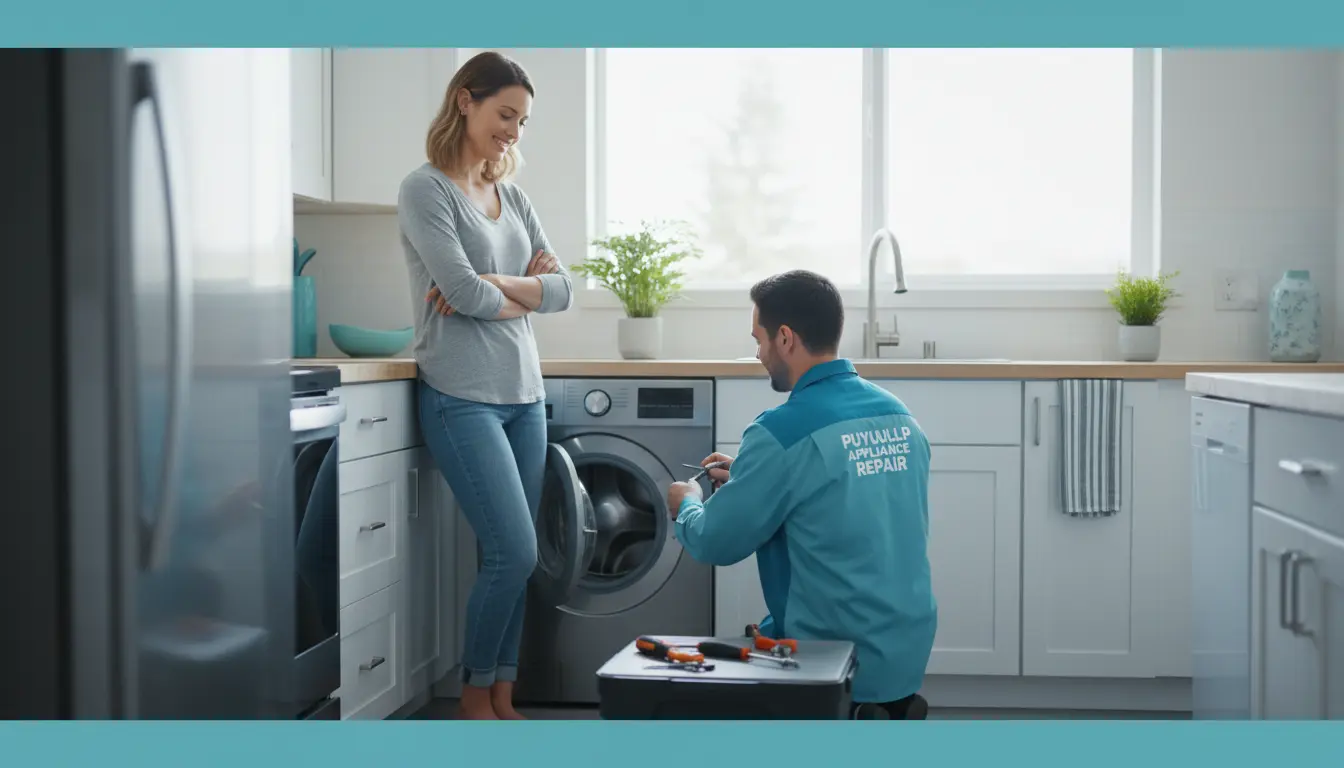
Most busy Puyallup homeowners assume that when a washer or dryer breaks, the quickest solution is to replace it. In reality, that assumption often leads to unnecessary expense and downtime, especially when a simple component-level repair could restore full operation in under two hours. The Pacific Northwest climate, with its persistent moisture and moderate water hardness, creates specific wear patterns that are well understood by local technicians but often overlooked by homeowners rushing to buy new machines.
For households juggling work, school, and family commitments in Puyallup, a broken washer or dryer can derail an entire week. Yet the conventional wisdom of “just replace it” ignores the fact that modern appliances are built to last 10 to 15 years, and many failures occur in the first five years due to easily fixable issues like faulty door switches, failed thermistors, or clogged drain pumps. By understanding the true repair landscape, you can save hundreds of dollars and keep your laundry routine running smoothly.
This washer and dryer repair guide for busy Puyallup households will walk you through the professional diagnostic process, common pitfalls, and when to call in a certified technician. Whether you live in a historic home near downtown Puyallup or a new development in South Hill, the principles remain the same: precision diagnosis, quality parts, and expert execution.
Why Professional Diagnosis Matters in Puyallup’s Climate
Puyallup’s unique combination of damp air, soft-to-moderate water, and seasonal temperature swings creates conditions that accelerate wear on electronic components and mechanical seals. Moisture infiltration into control boards is a leading cause of intermittent failures, while scale accumulation from water hardness can clog heating elements and drain valves over time. A professional technician begins with a systematic evaluation using tools like a digital multimeter for continuity verification and ohm testing of heating elements, along with a clamp-on ammeter to check motor current draw.
These diagnostics go beyond simple error codes. For instance, a washer that fails to spin may trigger a “drain pump” error, but the real culprit could be a cracked lid switch or a corroded control board trace. Similarly, a dryer that stops heating often tests as a bad thermal fuse, but the underlying cause is frequently a restricted vent that caused the fuse to blow. A thorough inspection in Puyallup homes must account for local variables such as lint buildup from high-humidity drying cycles and the effects of hard water on solenoid valves.
By investing in professional diagnostics, you avoid the common mistake of swapping parts blindly — a practice that can turn a $50 repair into a $500 headache. Technicians trained in closed-loop refrigeration and thermal degradation principles can isolate the exact failure point, whether it’s a failed compressor start relay or a burned-out heater element, saving you time and money.
Step-by-Step Professional Repair Workflow
Preliminary Inspection and Safety Checks
Every repair begins with a visual inspection and safety verification. The technician checks for obvious signs of damage, such as frayed wires, burned terminals, or water leaks. They then confirm that the appliance is properly grounded and that the outlet provides the correct voltage. In Puyallup, older homes may have wiring that doesn’t meet modern amperage requirements, so a voltage drop test at the terminal block is standard practice. This step prevents dangerous electrical shorts and ensures the appliance receives stable power.
Component Isolation and Testing
Using a digital multimeter set to resistance mode, the technician tests each component individually. For a washer, this includes the door lock, pressure switch, drain pump, and motor windings. For a dryer, they test the thermal fuse, high-limit thermostat, heating element, and drive motor. Continuity verification confirms that electrical paths are intact, while ohm testing checks for shorts or open circuits. Specialized diagnostic software linked to the appliance’s control board can read fault codes and run self-tests, pinpointing issues like a stuck relay or a failed sensor.
System Flushing and Descaling
In Puyallup’s water profile, scale accumulation inside the washer’s heating element or the dryer’s moisture sensor can cause erratic operation. Professional technicians use a descaling calibration solution to flush the system, removing mineral deposits that interfere with performance. This step is especially important for front-load washers, where scale buildup can lead to bearing failure and leaky seals. After descaling, the technician recalibrates the machine’s sensors to ensure accurate water temperature and drum balance.
Data Comparison: Component-Level Repair vs. Sub-Assembly Replacement
| Feature/Metric | Professional Component-Level Repair | Complete Sub-Assembly Replacement |
|---|---|---|
| Diagnostic Time | 30–45 minutes (targeted ohm testing, continuity verification) | 15–20 minutes (visual inspection, error code reading only) |
| Part Longevity | Matches original OEM lifespan when using factory-authorized parts | May be shorter if sub-assembly is generic or aftermarket |
| Structural Cost | $80–$150 for component + $100–$150 labor | $200–$400 for sub-assembly + $120–$200 labor |
| Warranty Coverage | Full 1-year parts and labor on OEM components | Often limited to 90 days on non-OEM sub-assemblies |
| Impact on Appliance Life | Restores original performance; no collateral damage | May introduce compatibility issues or void manufacturer warranty |
Source: NASTeC Core Appliance Service Reference Standard
Expert Insights from a Certified Technician
Three Advanced Diagnostic Tips
1. Check voltage drops at the terminal block. A loose neutral connection or undersized wire can cause intermittent power loss that mimics a control board failure. Using a multimeter on the incoming line while the appliance is running reveals dips that indicate an electrical issue upstream. This is common in Puyallup homes with older panels.
2. Perform seasonal dryer vent maintenance before diagnosing heating issues. In Puyallup’s damp climate, lint packs more tightly and reduces airflow faster than in drier regions. Before replacing a thermal fuse or thermostat, use a manometer to measure static pressure in the vent. A reading above 0.5 inches of water column indicates a restriction that will cause repeat failures.
3. Test thermal fuses using resistance scales under load. A fuse that reads continuity when cold may still fail under high current. Connect the fuse in series with a known resistor and measure the voltage drop. This catches intermittent failures that standard continuity checks miss.
Common Mistakes Homeowners Make
Overloading laundry drums causing structural bearing failure. Many Puyallup households try to maximize each load, but stuffing a washer beyond its rated capacity puts excessive stress on the drum bearings and suspension springs. This leads to loud noises, leaks, and eventual seal failure. A professional repair for a broken bearing can cost $300–$500, while a simple load adjustment prevents the issue entirely.
Using chemical drain cleaners in dishwashers destroying internal rubber seals. While this is more common in dishwashers, some homeowners also pour drain cleaners into washer drain pumps. The harsh chemicals degrade rubber seals, bellows, and pump impellers, causing leaks and eventual motor burnout. The result is a total control board short-circuit or mechanical lockup, requiring a full pump replacement.
Ignoring minor refrigerator clicking cycles indicating compressor relay burnouts. Similarly, a washer that clicks but doesn’t start may have a failing start relay or capacitor. Homeowners often ignore these sounds until the motor fails completely, turning a $30 relay replacement into a $250 motor repair.
Pricing Structures for Puyallup Appliance Repair
- Standard diagnostic trip fee: $75–$95, which covers the technician’s travel time and initial inspection. This fee is typically waived if you proceed with the repair.
- Tiered repair rates based on appliance complexity: Simple mechanical repairs (e.g., belt replacement, door latch) range from $80–$120. Electronic control board repairs or sealed system work (e.g., compressor replacement) run $150–$250 per hour.
- Flat-rate structural pricing for specific tasks: Heating element replacement for a dryer is often a flat $199 including parts and labor. Washer drain pump replacement is $179. These flat rates provide predictability for busy households.
Three factors that influence cost: premium luxury brand OEM parts sourcing (e.g., Bosch, Miele) can increase parts costs by 30–50%; advanced electronic control module flashing requires specialized software and adds $50–$75 to labor; physical accessibility of custom built-in residential kitchen layouts (e.g., stacked washer/dryer units in closets) may require extra time to disassemble cabinetry.
Safety Standards and Certifications
All professional technicians at Puyallup Appliance Repair hold EPA Section 608 certification for handling refrigerants, NASTeC Certified Appliance Technician credentials, and follow OSHA electrical safety grounding protocols. These certifications ensure that every repair is performed to the highest industry standards, minimizing risks of electric shock, fire, or refrigerant leaks.
Using factory-authorized OEM replacement parts is non-negotiable. Aftermarket parts often lack the same thermal and electrical tolerances, leading to premature failure or even safety hazards — especially in heating elements and control boards. For example, a dryer heating element from a generic manufacturer may exceed the recommended wattage, causing overheating and potential fire. OEM parts are engineered to match the appliance’s exact specifications, preserving warranty coverage and ensuring safe operation.
In Puyallup, where dryer vent clogs are a leading cause of house fires, professional technicians also perform dryer vent cleaning to remove lint buildup and reduce fire risk. This service is often combined with a repair to ensure the appliance operates safely and efficiently.
Frequently Asked Questions
How long does a typical washer or dryer repair take?
Most repairs are completed within one to two hours, including diagnostics and parts replacement. Complex issues like control board replacements or sealed system work may require additional time, but the technician will provide an estimate upfront. For busy Puyallup households, same-day service is often available to minimize disruption.
Can I repair my washer or dryer myself to save money?
While some simple fixes like replacing a belt or cleaning a lint filter are DIY-friendly, most repairs require specialized tools and knowledge. Misdiagnosing a problem can lead to buying the wrong part, voiding the warranty, or creating a safety hazard. For example, a failed thermistor might be misidentified as a defective control board, leading to a $200 expense that doesn’t fix the issue. Professional diagnostics ensure the right part is replaced the first time, saving money in the long run.
What are the most common washer problems in Puyallup?
The most frequent issues are drain pump failures (often due to small objects like coins or hairpins), door lock malfunctions, and water leaks from worn-out hoses or seals. Puyallup’s water hardness contributes to scale buildup on heating elements, which can cause temperature fluctuations and error codes. A professional can perform a washer leak repair and descale the system to restore normal operation.
How often should I have my dryer vent cleaned?
In Puyallup’s humid climate, dryer vents should be cleaned at least once a year to prevent lint accumulation and reduce fire risk. Signs that cleaning is needed include longer drying times, a burning smell, or excessive heat in the laundry room. Professional dryer vent cleaning not only improves safety but also extends the life of the dryer by reducing strain on the heating element and motor.
What should I do if my washer stops mid-cycle?
First, check if the machine is receiving power and if the door is fully closed. If the error code indicates a drain issue, inspect the drain hose for kinks or clogs. If the problem persists, it’s best to call a professional to avoid electrical shock or further damage. For a comprehensive overview of common issues, refer to How to Fix Common Washing Machine Issues at Home.
Professional Appliance Care in Puyallup
Maintaining your washer and dryer is about more than just fixing breakdowns — it’s about preserving the efficiency and reliability of your home’s core systems. By addressing issues early with professional diagnostics and using OEM parts, you avoid the cascading failures that lead to premature replacement. In Puyallup, where time is precious and the climate adds extra stress to appliances, a proactive approach pays off.
Puyallup Appliance Repair stands ready to serve your household with certified technicians, same-day service, and a commitment to quality. Whether you’re dealing with a leaky washer, a noisy dryer, or a complete breakdown, our team has the expertise to get your laundry room back in order fast. For more tips on preventing common problems, check out Why Dryers Break Down: Stats and Fixes for Locals and Puyallup’s Most Common Appliance Problems This Year.