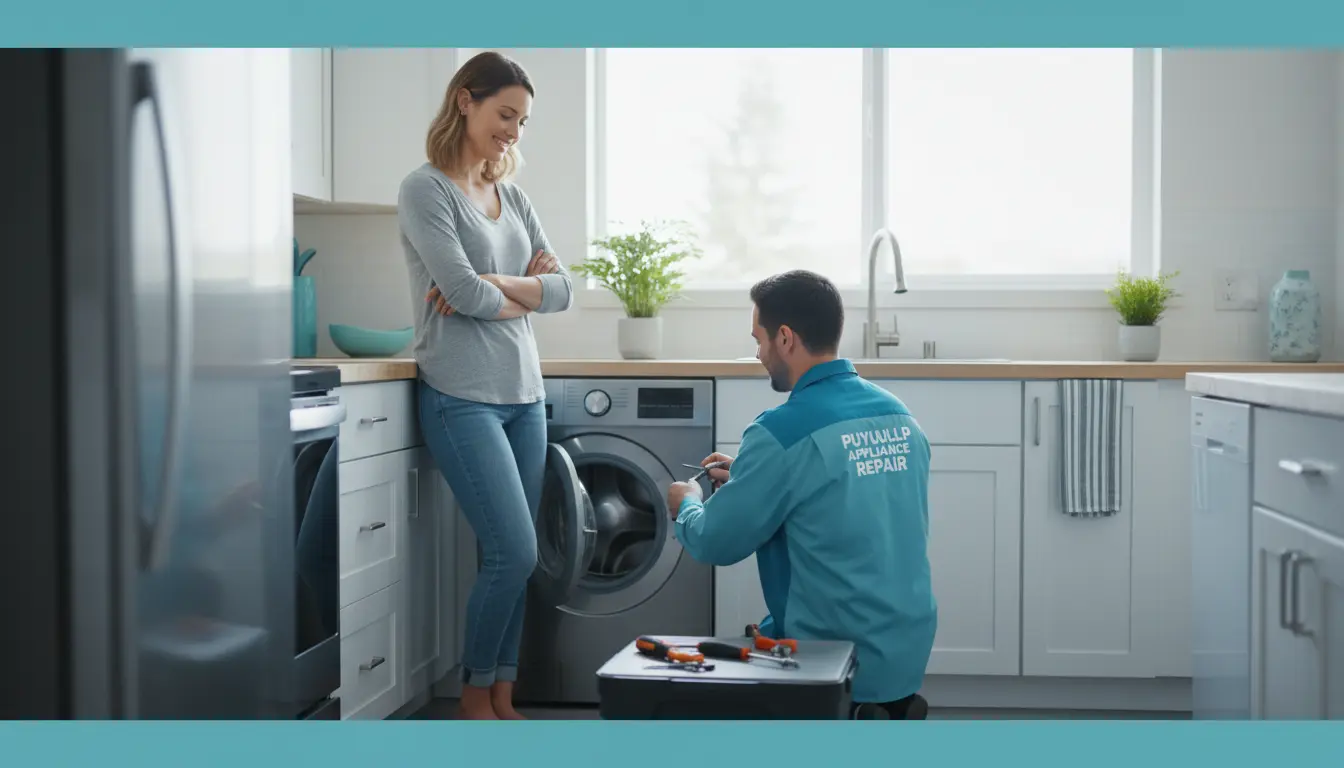
That $350 emergency service call for a refrigerator that stopped cooling — only to find out the condenser coils were caked with dust and the fan motor had seized — is a scenario many seniors in Puyallup neighborhoods know all too well. The real frustration isn’t just the cost; it’s knowing that a simple quarterly cleaning and a timely inspection could have prevented the entire breakdown. In Puyallup’s unique climate, where persistent Pacific Northwest moisture seeps into electronic housing seals and soft-to-moderate water profiles slowly coat heating elements, the margin for error is thin. Ignoring minor symptoms like a clicking refrigerator cycle or a dishwasher that leaves spots often leads to a total control board short-circuit or a sealed system failure — repairs that can easily exceed $800.
For seniors living in neighborhoods like South Hill, Meador Park, or Riverside, the decision to attempt a DIY fix or delay calling a professional can feel like a gamble. But the stakes are higher when you consider the physical demands of reaching behind heavy appliances, the risk of electrical shock from ungrounded outlets, and the potential for fire hazards from clogged dryer vents. That’s why understanding the appliance repair tips for seniors in Puyallup neighborhoods isn’t just about saving money — it’s about maintaining independence, safety, and the long-term reliability of the machines that keep your home running. Puyallup Appliance Repair brings factory-certified expertise straight to your door, ensuring that every diagnosis and repair follows the highest standards of the Marcone Servicers Association and NASTeC guidelines.
Professional Diagnostics: The Step-by-Step Workflow That Protects Your Appliances
When a technician arrives at a home in Puyallup, the process begins long before any tools are laid out. The first step is a thorough visual inspection of the appliance’s surroundings — checking for signs of moisture intrusion, unusual voltage fluctuations, or improper ventilation. Many older homes in neighborhoods like Woodland and Sumner still have ungrounded two-prong outlets, which can cause erratic behavior in modern electronic control boards. A certified technician will always start with a digital multi-meter (DMM) to check incoming voltage at the terminal block, verifying that the appliance receives 120V ± 5% for standard units or 240V for electric ranges and dryers.
Next comes the continuity verification phase. Using a clamp-on ammeter and a specialized oven probe, the technician tests each component — from the compressor start relay to the dishwasher’s drain pump — to identify resistance values that deviate from the manufacturer’s specifications. For example, a refrigerator’s evaporator fan motor should show a resistance between 100 and 200 ohms on the DMM; if the reading is open or shorted, the motor is failing. In Puyallup’s humid environment, thermal degradation of wire insulation inside the motor housing is common, leading to intermittent failures that are impossible to detect without ohm testing. This precision approach ensures that only the faulty component is replaced, not the entire sub-assembly, saving homeowners hundreds of dollars.
Component-Level Repair vs. Complete Sub-Assembly Replacement: A Data Comparison
One of the biggest decisions homeowners face during a repair is whether to replace just the faulty component — like a start capacitor or a door latch — or the entire sub-assembly, such as the main control board or motor assembly. The table below, based on the NASTeC Core Appliance Service Reference Standard, compares the two approaches across key metrics that directly affect your wallet and your appliance’s lifespan.
| Feature/Metric | Professional Component-Level Repair | Complete Sub-Assembly Replacement |
|---|---|---|
| Diagnostic Time | 30–60 minutes (requires precise component isolation) | 15–30 minutes (swap entire board or motor) |
| Part Longevity | Restores original life expectancy if OEM part is used | Often matches OEM life, but residual issues may remain |
| Structural Cost | $50–$150 for the component + labor | $200–$600 for the sub-assembly + labor |
| Risk of Recurrence | Low, if root cause (e.g., moisture, voltage) is addressed | Moderate, if underlying issue (e.g., poor ventilation) is ignored |
| Warranty Coverage | Typically 90 days to 1 year on parts | Often 1 year on entire sub-assembly |
For seniors in Puyallup neighborhoods, component-level repair is often the smarter choice because it avoids the inflated cost of a full sub-assembly swap while still addressing the exact failure point. However, it requires a technician who understands the nuances of closed-loop refrigeration cycles and electronic control board diagnostics — exactly the expertise that Puyallup Appliance Repair provides. If you’re curious about the most common failures in the area, refer to Puyallups Most Common Appliance Problems This Year for a detailed breakdown.
Expert Insights: Three Advanced Diagnostic Tips Every Senior Should Know
Check Voltage Drop at the Terminal Block
Many intermittent appliance issues — like a dryer that stops mid-cycle or a refrigerator that runs but doesn’t cool — are caused by a loose or corroded connection at the terminal block where the power cord meets the appliance. A technician will use a DMM to measure voltage under load (while the appliance is running). If the voltage drops more than 5% from the nominal line voltage, the connection is failing. In Puyallup, where older homes in neighborhoods like East Main and North Hill may have aging wiring, this is a frequent culprit. Simply tightening the screws or replacing the terminal block can resolve the issue without any component replacement.
Seasonal Dryer Vent Maintenance
Puyallup’s rainy winters mean that dryer vents are often subjected to moisture-laden air, which accelerates lint buildup and creates a fire hazard. A simple test: hold a piece of tissue paper near the vent flap while the dryer is running. If the paper doesn’t pull firmly against the flap, the vent is partially blocked. Most seniors can access the vent opening with a dryer vent brush, but for deep clogs, a professional vacuum and inspection are recommended. Ignoring this can lead to thermal cutoff failures or even fires, as documented in Why Dryers Break Down Stats And Fixes For Locals.
Testing Thermal Fuses Using Resistance Scales
A thermal fuse is a one-time safety device that blows when the temperature exceeds a set threshold (usually around 200°F). If your dryer runs but doesn’t heat, or your oven doesn’t bake evenly, the thermal fuse may be blown. Using a DMM set to resistance (ohms), a technician can test the fuse — if it reads infinite resistance, it’s open. The trick is to ensure the appliance is completely unplugged before testing, and to check the fuse’s markings for the correct operating temperature. Replacing a thermal fuse costs under $20, but misdiagnosing it as a failed heating element can cost $150 or more.
Common Mistakes That Lead to Expensive Repairs
One of the most frequent errors among seniors is overloading the washing machine drum. When the drum is packed beyond its capacity, the bearings experience excessive lateral stress, leading to noise, vibration, and eventually a seized drum. A bearing replacement on a front-load washer can cost $400–$600, whereas following the manufacturer’s load size guidelines costs nothing. Another mistake is using chemical drain cleaners in dishwashers. These harsh chemicals degrade the rubber seals around the pump and spray arms, causing leaks that require a full seal kit replacement. Instead, use a monthly vinegar rinse or a dishwasher-safe cleaning tablet. Finally, ignoring a refrigerator’s clicking cycle — a sound that indicates the compressor relay is struggling to engage — can lead to a burned-out compressor, which is a sealed system repair costing $500–$800. Early detection by a technician can often replace just the relay for under $100.
Pricing Structure for Appliance Repairs in Puyallup
- Standard Diagnostic Trip Fee: $75–$99, which covers the technician’s visit and a thorough inspection. This fee is typically waived if you proceed with the repair.
- Tiered Repair Rates: Based on appliance complexity. Simple repairs (e.g., replacing a thermocouple, cleaning a drain pump) cost $100–$200. Intermediate repairs (e.g., replacing a control board, motor) run $200–$400. Complex sealed system repairs (e.g., refrigerant recharge, compressor replacement) range from $500–$1,200.
- Factors That Influence Cost:
- OEM parts for premium luxury brands (e.g., Sub-Zero, Wolf) are 30–50% more expensive than generic parts.
- Advanced electronic control module flashing — required for some modern appliances — adds $50–$100 to the labor cost.
- Physical accessibility of built-in appliances in custom kitchens (e.g., sliding out a refrigerator in a tight alcove in a historic home in Downtown Puyallup) can increase labor time by 30–60 minutes.
Safety and Standards: Protecting You and Your Home
Every repair conducted by Puyallup Appliance Repair follows strict safety protocols. Technicians are EPA Section 608 certified for handling refrigerants, ensuring that any sealed system work is performed without releasing harmful gases into the environment. All electrical work adheres to OSHA standards, including lockout/tagout procedures to prevent accidental energization during repairs. Grounding verification is a mandatory step before any power-on testing, especially in older homes with ungrounded outlets. Additionally, only factory-authorized OEM replacement parts are used. This maintains the manufacturer’s warranty compliance and guarantees that the part’s thermal and electrical ratings match the original design. Using off-brand parts can lead to overheating, electrical shorts, or even fire — a risk that seniors in Puyallup should never take.
Frequently Asked Questions
How often should I have my refrigerator coils cleaned?
In Puyallup’s humid climate, dust and pet hair mix with moisture to form a paste that clogs condenser coils more quickly than in drier regions. Professional cleaning every 6 to 12 months is recommended. If you notice the compressor running constantly or the fridge feeling warm, schedule a cleaning immediately. A technician can also check the evaporator fan and drain pan for mold buildup, which is common in the wet Pacific Northwest.
What does a clicking sound from my dishwasher mean?
A single click at the start of a cycle is normal — it’s the detergent dispenser releasing. However, repeated clicking during the wash cycle usually indicates a failing drain pump or a stuck check valve. The pump’s impeller may be obstructed by a glass shard or a piece of food. If the clicking is accompanied by a humming sound, the pump motor may be drawing too high amperage due to a seized bearing. A technician can perform ohm testing on the pump windings to confirm the diagnosis.
Is it safe to use an extension cord with my washing machine?
No. Washing machines draw high inrush current during the spin cycle, and a standard extension cord can overheat, melt, or cause a voltage drop that damages the motor control board. If your outlet is too far from the machine, hire a licensed electrician to install a dedicated grounded outlet. The same applies to dryers and refrigerators.
How can I tell if my oven’s thermostat is accurate?
Place an oven-safe thermometer in the center of the rack and preheat the oven to 350°F. After 15 minutes, compare the thermometer reading to the set temperature. A variance of more than 25°F indicates a faulty thermostat or sensor. The sensor is a thermistor that changes resistance with temperature; a technician can test it with a DMM and compare the reading to a temperature-resistance chart. Replacing the sensor costs around $50–$80 and restores baking accuracy.
Professional Appliance Care in Puyallup
Maintaining the electromechanical systems in your home isn’t just about convenience — it’s about preserving the value of your investment and ensuring your safety. For seniors in Puyallup neighborhoods, having a trusted, factory-certified technician who understands the local building infrastructure and climate conditions makes all the difference. Whether you’re in South Hill, Summit, or Riverside, Puyallup Appliance Repair offers the diagnostic precision, component-level repair expertise, and commitment to safety that keeps your appliances running efficiently for years. Don’t wait until a minor issue becomes a major expense. Call today to schedule a thorough inspection and take the first step toward worry-free appliance ownership.