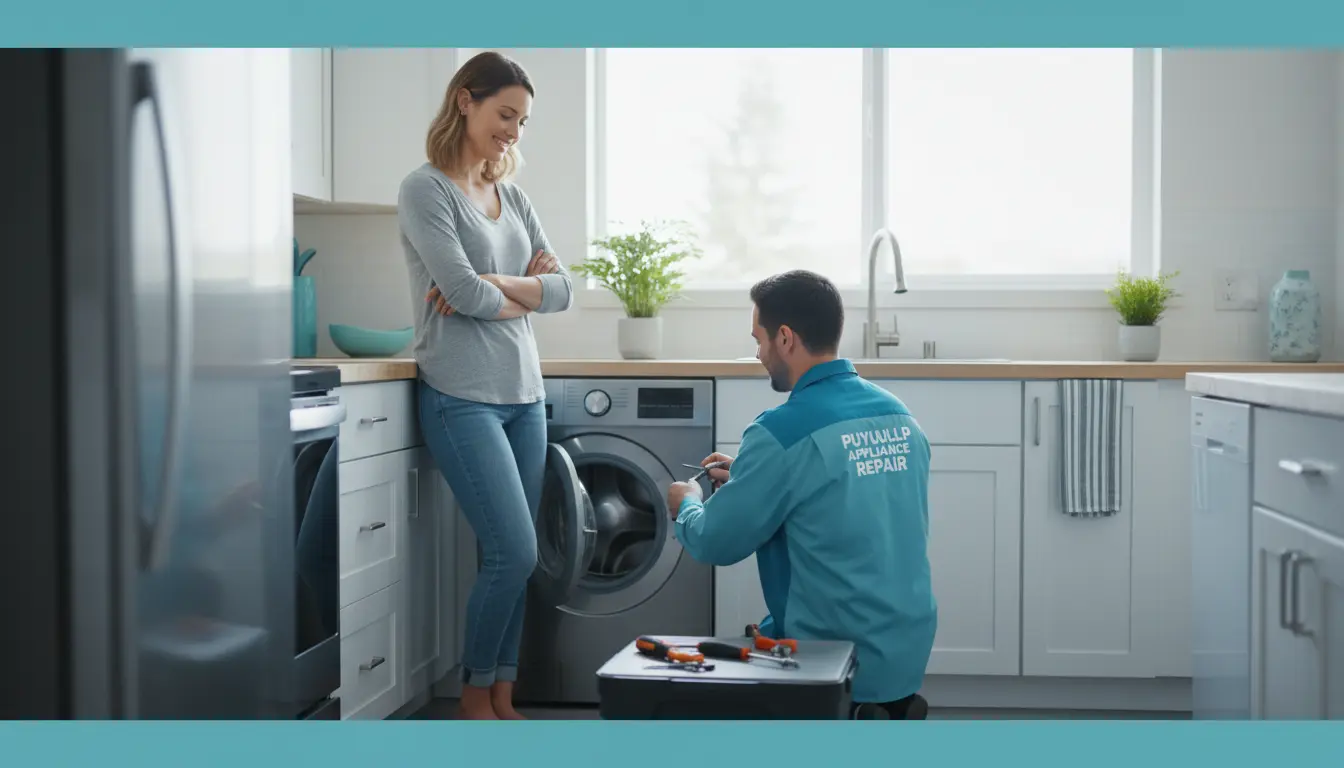
When an appliance fails catastrophically after business hours, the stress compounds quickly. You are not just losing a convenience; you are losing hundreds of dollars in groceries, a day of productivity, or the ability to host a holiday meal. The search for a reliable, factory-authorized technician in Puyallup often turns into a scramble through review sites and listing services that prioritize ad spend over actual competence. Knowing exactly how to find emergency appliance repair services near me in Puyallup means understanding who to call, what to ask, and what red flags to avoid before the technician even arrives at your door.
This guide walks you through the precise process of vetting, contacting, and working with a professional appliance repair service in Puyallup. It covers the technical workflow a qualified technician follows, how pricing works for after-hours calls, and the safety standards that separate a professional repair from a dangerous patch job. By the end, you will have a repeatable system for handling any urgent appliance failure—whether it’s a refrigerator, washer, dryer, oven, or dishwasher.
Understanding Urgent vs. Routine Appliance Failures
Not every appliance hiccup qualifies as an emergency. A clicking ice maker that stops producing cubes is an annoyance, not a crisis. A refrigerator that climbs above 40°F or a freezer that crosses 10°F, however, demands immediate attention because the risk of food spoilage and bacterial growth escalates quickly with every degree of temperature rise. Similarly, a washing machine that floods the laundry room floor during a spin cycle or a gas oven that fails to light creates immediate safety and property damage concerns.
In Puyallup, the mix of older historic homes near the downtown core and newly built developments creates a unique set of failure patterns. Older homes often have aging electrical infrastructure that can cause voltage fluctuations, stressing control boards and compressor relays. Newer homes, while built to modern code, sometimes feature appliances with complex electronic interfaces that are more sensitive to the region’s moderate water hardness. Understanding the difference between a minor component failure and a system-level breakdown helps you decide whether a same-day visit from a certified technician is necessary or if a scheduled service call will suffice.
If your appliance is still running but performing poorly—a dryer taking two cycles to dry a load, a dishwasher leaving residue on glasses, an oven struggling to hold temperature—you have time to research. But when the machine is dead, leaking, smoking, or making grinding sounds, treat it as an emergency. Call a service that offers emergency appliance repair and can dispatch a technician within hours, not days.
Step-by-Step Process for Finding a Reliable Emergency Technician
Verify Credentials Before Dialing
Start by confirming that the service provider is licensed, insured, and bonded for work in Washington State. Washington does not require a statewide appliance repair license, but the city of Puyallup and Pierce County often require a general business license and proof of liability insurance for tradespeople working in residential properties. Ask for the company’s Washington business license number and verify it through the Secretary of State’s database. A legitimate company will provide this information without hesitation.
Next, confirm that the technicians hold relevant certifications. For refrigeration and freezer repairs, the technician must have an EPA Section 608 certification to handle refrigerants legally. For gas appliances, look for technicians who have completed manufacturer-specific training from brands like Whirlpool, Samsung, LG, GE, or Frigidaire. Factory-authorized technicians have access to proprietary diagnostic software and OEM parts that third-party repairers cannot source. This distinction often determines whether a repair lasts five years or fails within six months.
Ask the Right Screening Questions
When you call, ask three specific questions. First: “Do you perform component-level diagnostics, or do you only swap entire sub-assemblies?” A technician who carries a digital multimeter and understands how to ohm-test a compressor winding or verify continuity across a thermal fuse can often repair a $10 part instead of replacing a $300 control board. Second: “Do you stock OEM parts on your truck, or will you need to order them?” Emergency repairs lose their value if the technician diagnoses the problem but cannot fix it until next week. Third: “What is your diagnostic fee, and does it apply to the repair cost if I proceed?” Transparent pricing upfront prevents surprises after the work is done.
Puyallup’s climate adds another layer to the screening process. Ask the technician how they handle moisture-related failures in electronic housing seals. A qualified professional will explain that they perform a visual inspection for corrosion on terminal blocks and relay contacts, clean any residue with an electronic contact cleaner, and apply a dielectric compound to prevent future ingress. This level of detail separates a specialist from a general handyman.
Check Local Reputation and Response Time
Online reviews matter, but they must be read critically. Look for patterns in reviews that mention specific appliance brands, types of failures, and timeliness. A company that serves the entire South Sound region may have excellent reviews in Tacoma but slow response times for Puyallup addresses. Ask directly: “How quickly can a technician be at my home in Puyallup?” If they cannot give a specific window within two hours for an emergency call, keep searching.
Local companies like Downtown Puyallup residents often have the advantage of shorter travel times and familiarity with the area’s housing stock. A technician who knows that homes along the Puyallup River may have older electrical panels can anticipate voltage issues before they cause secondary damage to a new appliance.
The Professional Diagnostic Workflow
A certified technician follows a methodical sequence when they arrive at your home. The process is not guesswork; it is a scientific approach to isolating the root cause of the failure. Understanding this workflow helps you evaluate whether the technician is competent or simply trying to sell you a new machine.
The first step is a visual and auditory inspection. The technician listens for abnormal sounds—clicking from a compressor relay that indicates a failing start capacitor, a hum from a washing machine motor that suggests a seized bearing, or a hiss from a gas valve that points to a safety shut-off issue. They look for obvious signs like burnt wiring, melted plastic, or water pooling around the base of the appliance. In Puyallup, they also check for moisture intrusion around door seals and control panel gaskets, as the damp climate accelerates corrosion on exposed terminals.
Next, the technician uses a digital multimeter to perform electrical testing. They check voltage at the wall outlet to ensure the appliance is receiving proper power—typically 120V or 240V depending on the appliance. They then isolate the main control board and test for incoming power. If voltage is present but the board is unresponsive, they trace the circuit to check for blown fuses, damaged relays, or cold solder joints. This process, known as continuity verification, confirms whether electricity can flow through each component without interruption.
For refrigeration systems, the technician attaches manifold gauges to the service ports to measure the high and low side pressures. A sealed system that has lost refrigerant will show low suction pressure and high discharge pressure, indicating a leak. The technician then performs a leak search using an electronic leak detector or, for stubborn leaks, a nitrogen pressure test. If a leak is found, the repair involves recovering the remaining refrigerant, replacing the faulty component (often an evaporator coil or a condenser), evacuating the system to remove moisture and non-condensables, and recharging it with the exact manufacturer-specified refrigerant weight.
For motor-driven appliances like washers and dryers, the technician tests the motor windings for resistance values that fall within the manufacturer’s specifications. A motor showing an open winding—infinite resistance—is dead and must be replaced. A motor with a short-to-ground—low resistance to the motor frame—is dangerous and must also be replaced. They also check the capacitor, which stores electrical energy to start the motor, using a capacitance meter. A capacitor that has drifted outside its rated tolerance will cause the motor to hum without spinning or to run hot and fail prematurely.
Data Comparison: Component-Level Repair vs. Sub-Assembly Replacement
The table below compares two common repair approaches for a non-functioning refrigerator control board. This data reflects typical outcomes for residential appliances in the Puyallup market.
| Feature / Metric | Professional Component-Level Repair | Complete Sub-Assembly Replacement |
|---|---|---|
| Diagnostic Time | 45–90 minutes (requires detailed ohm testing and voltage tracing) | 15–30 minutes (identify failed assembly, swap whole unit) |
| Part Longevity | 3–7 years (OEM-grade replacement capacitors, relays, or fuses) | 3–7 years (OEM assembly, same lifespan as original) |
| Structural Cost | $85–$180 (diagnostic fee plus minor parts) | $250–$600 (assembly cost plus diagnostic fee) |
| Environmental Impact | Low (replaces only failed component, less e-waste) | Higher (entire assembly discarded) |
| Skill Level Required | Advanced (requires schematic reading and soldering ability) | Moderate (basic disassembly and reconnection skills) |
Both approaches can produce a reliable repair when performed by a qualified technician. Component-level repair is often more cost-effective and sustainable, but it requires a higher level of diagnostic skill. Sub-assembly replacement is faster and reduces the chance of a missed hidden fault, but it costs more upfront. A professional technician should explain both options and let you choose based on your budget and the appliance’s age.
Professional Diagnostic Tips from a Certified Technician
Experienced technicians develop diagnostic shortcuts that save time without sacrificing accuracy. These three tips come directly from field practice in the Pacific Northwest.
Tip 1: Check Voltage Drop at the Terminal Block. A refrigerator that runs intermittently or a washing machine that stops mid-cycle often has a compromised connection at the terminal block where the power cord meets the appliance. Use a multimeter to measure voltage at the block while the appliance is running. If the voltage drops below 108V on a 120V circuit, the connection is corroded or loose. Tightening the terminals or replacing the block usually resolves the issue. In Puyallup, moisture from humid air can accelerate corrosion on these blocks, especially in garages or uninsulated laundry rooms.
Tip 2: Test Thermal Fuses Using the Resistance Scale. Dryers and ovens use thermal fuses that blow when the appliance overheats. These fuses are designed to fail once and cannot be reset. Many homeowners replace the fuse only to have it blow again because they did not address the root cause—a clogged vent or a failed heating element. To confirm a blown thermal fuse, set your multimeter to the continuity or resistance mode. A good fuse will read near zero ohms. An open fuse will read infinite resistance. Always check the vent path before replacing the fuse.
Tip 3: Listen for Clicking Patterns in Refrigerators. A refrigerator that clicks repeatedly without starting the compressor is often suffering from a failing start relay or overload protector. The relay clicks as it tries to energize the compressor, but the compressor draws too much current, causing the overload to trip. This cycle repeats every few seconds. Replacing the relay and overload assembly is a common fix, but if the compressor itself has seized—evidenced by high resistance readings on the common-start-run windings—then the sealed system requires professional attention.
Common Homeowner Mistakes That Lead to Costly Repairs
Well-meaning homeowners often attempt quick fixes that worsen the problem. Three mistakes appear regularly in Puyallup service calls.
Mistake 1: Overloading the Washing Machine Drum. Stuffing a king-size comforter into a standard-capacity washer may seem efficient, but it places extreme stress on the drum bearings and suspension springs. Over time, the bearings wear unevenly, causing the drum to wobble during the spin cycle. This wobble can crack the outer tub, leading to a leak that requires a full disassembly to repair. A replacement tub and bearing assembly often costs more than half the price of a new machine. Always check the manufacturer’s maximum load weight and stick to it.
Mistake 2: Using Chemical Drain Cleaners in Dishwashers. When a dishwasher drains slowly, some homeowners pour chemical drain cleaners down the drain opening. These chemicals contain caustic sodium hydroxide or sulfuric acid that can eat through the rubber seals in the drain pump and the sump housing. Once the seals fail, water leaks onto the floor and into the control board area, causing a short circuit. A simple dishwasher leak can escalate into a total control board failure, costing $300 or more to repair. Instead, use a dedicated dishwasher cleaner tablet or remove the drain filter and clean it manually.
Mistake 3: Ignoring Intermittent Clicking in a Refrigerator. A refrigerator that clicks occasionally but still keeps food cold is easy to ignore. That clicking is often the compressor relay struggling to engage. Each failed attempt stresses the relay and the compressor winding. Eventually, the relay burns out completely, and the compressor may lock up from repeated overheating. Replacing the relay early costs about $25 and ten minutes. Waiting until the compressor fails requires a sealed system repair that runs $400 to $800.
Pricing Structure for Emergency Appliance Repair in Puyallup
- Standard diagnostic trip fee: Most services charge a flat fee ranging from $75 to $125 for the technician to arrive, evaluate the appliance, and provide a written estimate. This fee is typically waived if you approve the repair. Emergency after-hours calls may include a premium of $50 to $100 added to the diagnostic fee.
- Tiered repair rates based on appliance complexity: Simple repairs like replacing a dryer heating element or a dishwasher drain pump cost between $150 and $300, including labor and parts. Mid-complexity repairs such as replacing a washing machine control board or a refrigerator evaporator fan motor range from $250 to $450. Sealed system repairs for refrigerators or freezers—recovering refrigerant, replacing a compressor or evaporator, and recharging—generally run $400 to $900.
- Flat-rate structural pricing for specific tasks: Some services offer fixed prices for common jobs. For example, replacing a gas oven igniter might be a flat $180, while a refrigerator start relay replacement might be a flat $120. These flat rates provide certainty but may not include the diagnostic fee if the technician discovers additional issues.
- Factors influencing cost: Three variables affect the final price. First, OEM parts for premium luxury brands like Sub-Zero, Wolf, or Miele cost significantly more than generic equivalents and may have longer lead times. Second, appliances installed in custom built-in cabinetry with limited access require additional labor for disassembly and reassembly. Third, emergency calls on weekends or holidays command higher rates due to overtime staffing costs.
Safety Standards and Certifications That Matter
Every technician performing appliance repairs in Puyallup should adhere to established safety standards. These standards protect both the technician and your home from electrical hazards, gas leaks, and fire risks.
EPA Section 608 Certification. This certification is required by federal law for any technician who handles refrigerants. It covers proper recovery, recycling, and disposal of refrigerants, as well as leak detection and repair procedures. A technician without this certification cannot legally work on sealed refrigeration systems. Ask to see their EPA card before allowing them to connect gauges to your refrigerator or freezer.
NASTeC Certification. The National Appliance Service Technician Certification (NASTeC) is a voluntary but highly respected credential that demonstrates a technician has passed a comprehensive exam covering electrical theory, refrigeration, gas systems, and diagnostic procedures. Technicians with NASTeC certification are more likely to perform thorough diagnostics and follow manufacturer-recommended repair methods.
OSHA Electrical Safety Standards. OSHA standards require technicians to follow lockout/tagout procedures when working on live electrical systems, use insulated tools, and wear appropriate personal protective equipment. A professional technician will never work on a live appliance without first verifying that the power is disconnected and the capacitors are discharged. Capacitors can store a lethal charge even after the appliance is unplugged.
Factory-Authorized OEM Parts. Using genuine OEM parts ensures that the replacement component matches the original specifications for voltage, resistance, and physical dimensions. Aftermarket parts may be cheaper, but they often have looser tolerances that can cause premature failure or, in worst cases, create a fire hazard. A reputable service provider will always use OEM parts and provide a warranty on both parts and labor.
Dryer Vent Cleaning Standards. Dryer fires remain a leading cause of home fires in Washington State. The National Fire Protection Association (NFPA) recommends cleaning the dryer vent at least once a year. A professional technician performing a dryer repair will always inspect the vent path and recommend cleaning if they find excessive lint buildup. Dryer vent cleaning is a routine service that prevents overheating and extends the life of the dryer.
Frequently Asked Questions About Emergency Appliance Repair in Puyallup
What qualifies as an appliance emergency that requires immediate service?
An appliance emergency is any failure that poses an immediate safety risk or causes significant property damage or food loss. Examples include a refrigerator or freezer that stops cooling, a washing machine that floods the floor, a gas appliance that emits a gas smell, an oven that will not turn off, or any appliance that sparks, smokes, or trips the circuit breaker repeatedly. If the issue can wait until the next business day without causing damage or discomfort, it is usually a routine service call rather than an emergency.
How long does it typically take for an emergency technician to arrive in Puyallup?
Response times vary by service provider and time of day. For a true emergency, a reputable company should be able to dispatch a technician within two to four hours during normal business hours. After-hours or weekend calls may take longer due to limited staff availability. When you call, ask for a specific arrival window. If the company cannot give a window within two hours, consider whether another provider can respond faster. Local companies that serve the Puyallup area directly often have shorter travel times than region-wide franchises that dispatch from Tacoma or Federal Way.
Can I attempt any temporary fixes while waiting for the technician?
For safety reasons, limit your actions to unplugging or turning off the appliance at the breaker. Do not attempt to disassemble the machine, remove panels, or probe electrical components unless you have training and the proper tools. For a refrigerator or freezer failure, move food to a cooler with ice packs to preserve it. For a leaking washing machine, turn off the water supply valve behind the machine and block the leak with towels. For a gas smell, leave the house immediately and call 911 from outside. Do not operate any electrical switches or use a phone inside the home.
What information should I have ready when I call for emergency service?
Have the appliance brand, model number, and serial number available. These numbers are usually on a sticker inside the refrigerator compartment, on the back of the appliance, or on the frame behind the washer or dryer door. Also, describe the exact symptoms: what the appliance was doing when it failed, any unusual sounds or smells, and whether the breaker tripped. The more detail you provide, the better the dispatcher can assess whether the call is a true emergency and what parts the technician should bring.
If you need a more specific type of repair, ask about the company’s experience with your appliance. For example, if your refrigerator is failing, a technician with experience in refrigerator repair will be better equipped to handle sealed system issues. Similarly, washing machine repair specialists understand the nuances of belt-driven versus direct-drive systems.
How do I know if the repair is worth the cost versus buying a new appliance?
A general rule of thumb is that if the repair cost exceeds 50% of the price of a comparable new appliance, replacement is usually the better financial decision. However, consider the appliance’s age and overall condition. A ten-year-old refrigerator may have other components nearing the end of their life, so a $400 repair might only buy two more years of service. A three-year-old machine with a single failed component is almost always worth repairing. A qualified technician should give you a candid assessment of the appliance’s expected remaining lifespan and any known vulnerabilities that may fail soon.
Professional Appliance Care in Puyallup
When an appliance fails at the worst possible moment, having a reliable, factory-certified technician on speed dial makes all the difference. The process of finding emergency appliance repair services near me in Puyallup becomes straightforward when you know the right questions to ask, the certifications to verify, and the diagnostic workflow to expect. A professional repair not only restores function but also extends the life of your appliance and protects your home from safety hazards.
Puyallup residents face unique challenges from the region’s moisture, variable water quality, and mix of older and newer housing stock. A service provider that understands these local conditions and employs technicians with EPA Section 608 and NASTeC certifications offers the highest level of reliability. Whether you need a dishwasher repair after a flooded kitchen or a dryer repair to restore your laundry routine, choosing a technician who performs component-level diagnostics and uses OEM parts ensures the job is done right the first time.
Maintaining highly efficient electromechanical systems in your home requires proactive care and the confidence to act quickly when something goes wrong. By following the steps outlined here, you can handle any appliance emergency with clarity and purpose. For fast, professional service in Puyallup, call the team that lives and works in your community.
Final Thoughts
An appliance emergency does not have to spiral into a crisis. With the right preparation and knowledge, you can secure a skilled technician who will arrive promptly, diagnose accurately, and repair thoroughly. The key is to act decisively—verify credentials, ask detailed questions, and trust a provider that meets professional standards.
If you are facing an appliance failure right now, do not hesitate. Contact a certified emergency repair service in Puyallup and get your home back to normal as quickly as possible.