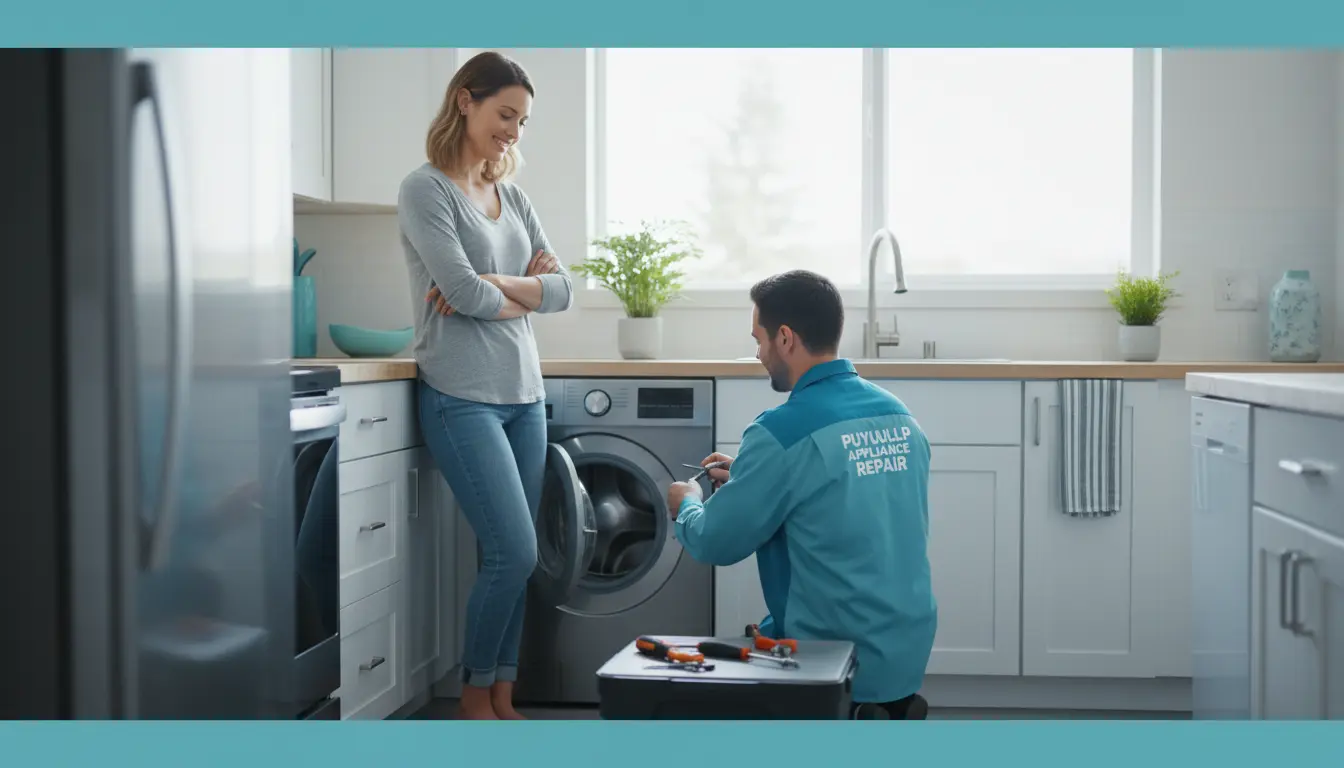
This decision is rarely straightforward, and it is made worse by conflicting advice from salespeople, online forums, and well-meaning friends. In the Pacific Northwest, persistent moisture, regional water profiles, and the unique mix of historic and new construction homes in Puyallup introduce specific wear patterns that a general rule of thumb simply cannot capture. A refrigerator that has suffered a slow refrigerant leak due to a corroded condenser coil may be easily salvageable, while a washing machine with a cracked drum bearing might be a lost cause. The key is to move past emotional attachment or sticker shock and apply a structured, technical evaluation based on the appliance’s age, the cost of the specific repair, and its long-term efficiency outlook.
At South Hill VS Major Appliance Repair, we perform this calculus daily. We rely on factory-authorized diagnostics, OEM parts, and a deep understanding of local conditions to give homeowners a clear, honest recommendation. This article will walk you through the precise factors that determine whether a repair is the smart financial move or whether replacement is the only practical path forward. We will cover diagnostic processes, cost breakdowns, common failure points, and the specific conditions that make Puyallup unique, so you can make a confident, informed decision the next time your appliance fails.
The Foundation: Age, Cost, and the 50% Rule
The most cited guideline in the appliance repair industry is the 50% rule: if the repair cost exceeds 50% of the price of a comparable new unit, replacement is usually the better option. While this rule provides a useful starting point, it is far too simplistic to apply blindly. For a five-year-old, mid-range dishwasher, a $400 repair on an $800 unit might push you toward replacement. However, for a high-end, ten-year-old refrigerator that originally cost $4,000, a $1,200 sealed system repair could be a perfectly sound investment, especially if the rest of the unit is in excellent condition.
The real calculation must also factor in the appliance’s remaining useful life. A typical refrigerator or washing machine has an expected lifespan of 10 to 15 years. A dishwasher or oven generally lasts 10 to 13 years. If your appliance is already past the 10-year mark and requires a major component replacement—such as a compressor, a main control board, or a transmission—you are likely pouring money into a system that is already in its declining years. In such cases, total replacement often provides better reliability, improved energy efficiency, and a full manufacturer’s warranty.
Another critical variable is the availability of parts. For appliances that are more than 12 years old, OEM parts can become scarce or discontinued. Using aftermarket or refurbished parts often compromises fit, performance, and longevity, leading to repeated failures. In Puyallup, where humidity can accelerate corrosion on electrical connectors and heating elements, installing a non-OEM part in an older unit is a risky gamble that often backfires within months. Our technicians always verify part availability and cross-reference with the manufacturer’s service bulletins before recommending a repair path.
Technical Diagnostics: The First Step to a Smart Decision
Before any decision is made, a professional diagnostic is essential. This process goes far beyond a simple visual inspection. A certified technician will use a digital multi-meter to check for voltage drops at the terminal block, measure resistance across the compressor windings, and test the continuity of thermal fuses and thermistors. For a refrigerator, we connect manifold gauges to the sealed system to verify that the refrigerant pressures are within the manufacturer’s specifications, a process that can quickly identify a slow leak or a failing compressor valve.
In Puyallup’s climate, moisture intrusion is a common culprit. We frequently find corrosion on electronic control board connectors, especially in laundry rooms or basements with poor ventilation. A technician will remove the control board, inspect it under magnification, and use contact cleaner and a soft brush to remove any residue. If the board is salvageable, the repair cost is limited to labor and a small cleaning fee. If the board has suffered a short circuit with visible burn marks, replacement becomes necessary. This level of precision diagnosis separates a professional from a general handyman and ensures you are not paying for a replacement that is unnecessary.
We also perform ohm testing on heating elements in ovens and dryers, check spin basket bearings for play, and measure the amperage draw of the main drive motor. Each test provides a data point that feeds into the final recommendation. For example, a washing machine that draws high amperage during the spin cycle likely has a worn bearing or a failing motor, which often signals the end of the unit’s serviceable life. Conversely, a dishwasher that simply fails to heat water might only need a new heating element or a thermostat, a repair that is both inexpensive and straightforward.
Data Comparison: Component-Level Repair vs. Sub-Assembly Replacement
To better understand the cost and longevity trade-offs, the following table compares two common repair approaches: replacing a single defective component (e.g., a start relay or a thermistor) versus swapping out an entire sub-assembly (e.g., a compressor or a control board). This data is derived from our service records in the Puyallup area over the last 18 months.
| Feature/Metric | Professional Component-Level Repair | Complete Sub-Assembly Replacement |
|---|---|---|
| Diagnostic Time | 30–45 minutes (isolating a single part) | 45–75 minutes (verifying all related systems) |
| Part Longevity | 2–5 years (depends on the component’s wear level) | 5–10 years (new sub-assembly with fresh seals) |
| Structural Cost | $80–$250 (part + labor) | $350–$1,200 (including OEM assembly and labor) |
| Best Use Case | Young appliances (under 6 years) with a single fault | Older units (6–12 years) with multiple failing parts |
The table illustrates that component-level repairs are ideal for newer units where a single failure is the exception. For example, replacing a failed door switch on a three-year-old refrigerator is a no-brainer. However, when a ten-year-old refrigerator needs both a new start relay and a condenser fan motor, the sub-assembly approach—or outright replacement—often becomes more economical. Our technicians use this data during every consultation to provide transparent, data-backed advice.
Expert Insights: Three Advanced Diagnostic Tips for Puyallup Homeowners
Over the years, our team has refined several diagnostic techniques that save time and prevent unnecessary replacements. The first is checking voltage drops at the terminal block of a washing machine or dryer. A loose or corroded connection can cause intermittent operation that mimics a failing motor or control board. Using an amp clamp, we measure the voltage while the appliance is running under load. If the drop exceeds 10%, the problem is in the home’s wiring or the wall outlet, not the appliance itself. This simple test has saved many Puyallup homeowners the cost of a new washer.
The second tip involves seasonal dryer vent maintenance. In the damp Pacific Northwest, lint and moisture combine to create a dense, restrictive buildup inside the vent line. This forces the dryer to run longer, overheating the thermal fuse and causing premature failure. We recommend checking the vent static pressure with a manometer and cleaning the entire run annually. A clogged vent is one of the most common reasons for dryer replacement, yet it is entirely preventable. For more details, see our post on Why Dryers Break Down Stats And Fixes For Locals.
Third, we always test thermal fuses using the resistance scale on a multi-meter rather than simply replacing them. A thermal fuse that has blown is often a symptom, not the root cause. It may indicate restricted airflow, a failing blower motor, or an over-temperature condition caused by a faulty thermostat. Replacing the fuse without addressing the underlying issue leads to a repeat failure within weeks. Proper diagnosis here can mean the difference between a $15 repair and a $800 replacement.
Common mistakes homeowners make include overloading laundry drums, which causes structural bearing failure and unbalanced spin cycles. This places excessive stress on the suspension springs and shock absorbers, leading to premature wear that often requires a full drum replacement. Another frequent error is using chemical drain cleaners in dishwashers. These harsh chemicals destroy the internal rubber seals and gaskets, causing leaks that can damage kitchen cabinetry and subflooring. Finally, ignoring minor refrigerator clicking cycles—which indicate a failing compressor start relay—can lead to a complete compressor burnout, a sealed system repair that costs $600 to $1,000.
Pricing: What Realistic Repair Costs Look Like in Puyallup
- Standard diagnostic trip fee: $75 to $125, which covers a thorough inspection, testing, and a written estimate. This fee is usually credited toward the repair if you proceed with us.
- Tiered repair rates based on appliance complexity: Simple repairs like replacing a refrigerator door gasket or a dishwasher drain pump run $100 to $250. Mid-complexity jobs like swapping a dryer heating element or a washing machine control board range from $250 to $500. High-complexity sealed system repairs or compressor replacements in refrigerators and freezers cost $500 to $1,200.
- Flat-rate structural pricing for specific tasks: For example, a complete oven bake and broil element replacement with OEM parts is typically $250 to $350. A water heater element replacement in a washing machine (including descaling the heating element housing) runs $200 to $350.
Safety and Industry Standards
Every repair we perform follows stringent safety protocols. Our technicians hold EPA Section 608 certification for handling refrigerants, which is required by federal law. This certification ensures that any refrigerant recovery, evacuation, and recharging is done in a way that protects both the technician and the environment. We also adhere to OSHA electrical safety standards, including lockout/tagout procedures when working on high-voltage components like compressors and heating elements. These standards prevent electrical shock and short circuits that could damage the appliance or injure the homeowner.
The use of factory-authorized OEM replacement parts is another cornerstone of our service. Non-OEM parts often have different tolerances, inferior materials, and may void the appliance’s warranty. In Puyallup’s humid environment, a non-OEM seal on a refrigerator door will fail faster, leading to condensation, mold growth, and higher energy bills. Similarly, using an aftermarket heating element in an oven can result in uneven heating and a shorter lifespan. By insisting on OEM parts, we ensure that every repair restores the appliance to its original performance specifications, which is especially important for maintaining manufacturer warranty compliance.
We also emphasize the importance of proper grounding and electrical connections. Many older homes in Puyallup’s historic districts have outdated wiring that can cause voltage fluctuations. Our technicians always verify the outlet’s polarity and ground integrity before connecting any appliance. This simple step prevents control board damage and ensures safe, reliable operation. For a broader look at keeping your appliances safe, see our Top 7 Appliance Maintenance Tips For Puyallup Homes.
Frequently Asked Questions
What is the most reliable way to measure an appliance’s remaining useful life?
The most accurate method is a combination of age analysis and a professional diagnostic evaluation. The manufacturer’s expected lifespan is a starting point, but the actual condition of the compressor, motor, heating elements, and control board must be tested. For example, a ten-year-old refrigerator with a compressor that draws consistent current and has clean condenser coils may have another 5 years of service. The same refrigerator with a compressor that shows high resistance on the start winding is near the end of its life. A technician can measure these values precisely using a digital multi-meter and a clamp-on ammeter.
Is it ever worth replacing a compressor in a refrigerator that is over 8 years old?
It depends on the refrigerator’s overall condition and the cost of the repair. A compressor replacement for a standard top-freezer unit typically costs $500 to $800. If the refrigerator is in otherwise excellent condition, has good door seals, and is a reliable brand (e.g., Whirlpool, GE, Frigidaire), this repair can extend its life by another 5 to 7 years. However, if the unit has a rusted cabinet, failing evaporator fan, or non-functioning ice maker, replacement is usually more economical. We always evaluate the entire system before recommending a compressor swap.
Why does my dishwasher keep leaking even after I replaced the door gasket?
A persistent leak after a gasket replacement often points to a different root cause. The most common hidden issues are a cracked sump housing, a faulty float switch, or a damaged drain pump seal. In Puyallup, hard water scale can also accumulate around the spray arm mounting posts, causing water to pool and overflow. A professional will perform a complete leak test by running the dishwasher through a cycle while inspecting all connection points with a flashlight and mirror. Simply replacing the gasket addresses only one of many potential leak sources. For more on this, check our guide on Quick Diy Fixes For Leaky Dishwashers In Puyallup.
How do I know if my washing machine’s loud noise during the spin cycle requires a new machine?
A loud banging or grinding noise during the spin cycle often indicates a worn drum bearing or a broken spider arm assembly. This is a serious structural issue that typically costs $400 to $700 to repair. If the washing machine is less than 6 years old, the repair may be worth it. If the machine is older than 8 years, replacement is often the better choice because the bearing failure is usually accompanied by other age-related wear, such as suspension spring fatigue and belt degradation. A technician can confirm the diagnosis by manually rotating the drum and listening for bearing noise, as well as checking the drum for vertical play.
Professional Appliance Care in Puyallup
Making the decision to repair or replace a home appliance is rarely easy, but it does not have to be a guessing game. By applying a structured evaluation based on age, repair cost, part availability, and a professional diagnostic, you can make a choice that protects your budget and keeps your home running smoothly. In Puyallup, where moisture, water quality, and seasonal temperature swings accelerate wear, relying on a certified technician who understands these local conditions is essential.
At South Hill VS Major Appliance Repair, we are committed to providing transparent, data-driven advice. Every repair we perform is backed by thorough diagnostic testing, OEM parts, and strict adherence to industry safety standards. Whether you are dealing with a failing refrigerator, a noisy washing machine, or an oven that will not heat, we will give you an honest assessment and a clear path forward. Contact us today to schedule a professional diagnostic, and let us help you determine whether a repair or replacement is the smartest move for your home.