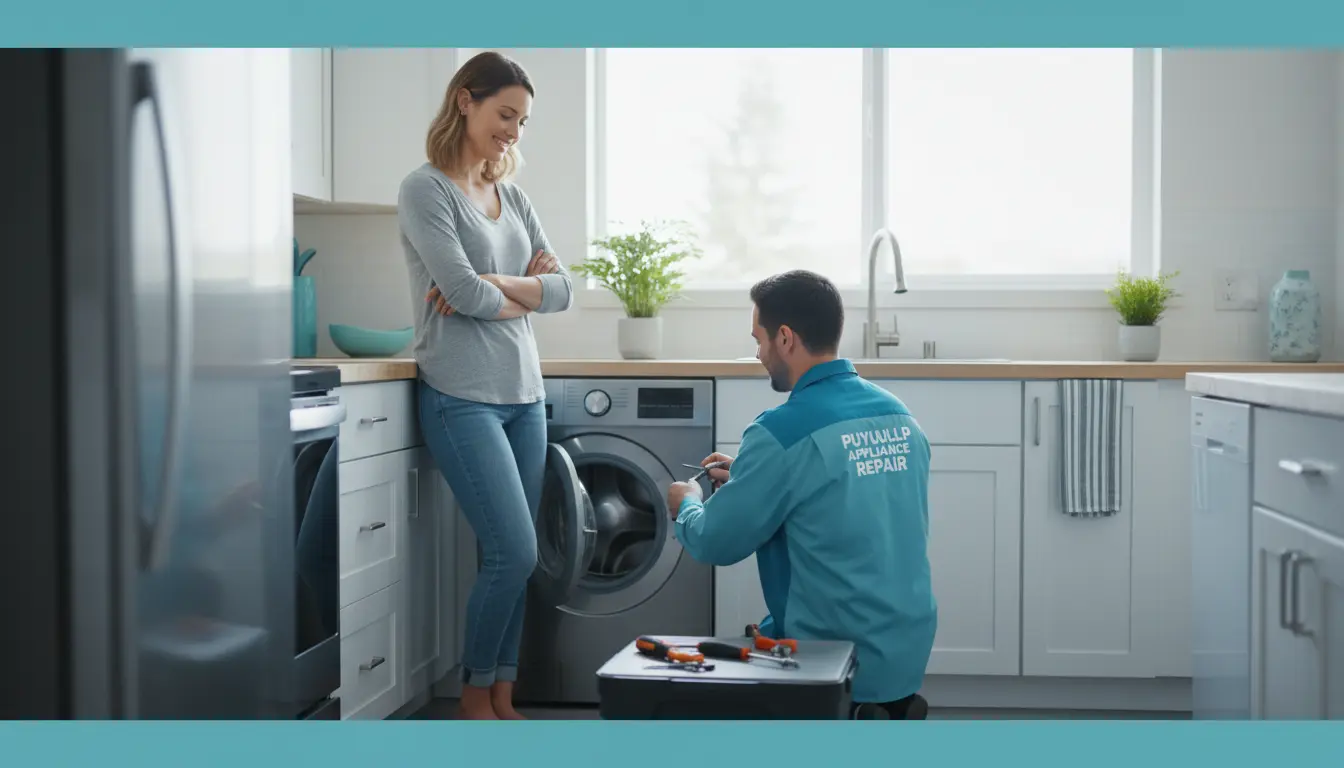
It was a damp October afternoon, and the technician had just finished pulling the access panel from a 1958 Frigidaire in a Craftsman home on North Meridian. The homeowner had reported intermittent cooling—a soft click followed by a long silence, then nothing. The compressor relay had carbonized, and the terminal block showed signs of micro-arcing, a textbook consequence of decades of seasonal humidity cycling inside Puyallup’s older neighborhoods. That moment underscores a broader truth: appliance repair tips for older homes in Puyallup neighborhoods must account for the unique convergence of aging infrastructure, persistent Pacific Northwest moisture, and electrical systems that were never designed for modern energy demands.
This guide is written for homeowners and property managers in Puyallup who want to understand the technical realities behind their appliances. We will walk through the diagnostic and repair process used by factory-certified technicians, compare repair strategies, highlight common oversights, and explain what to expect from a professional service. Every recommendation is grounded in NASTeC standards and practical experience with the region’s most common appliance failures.
Why Older Puyallup Homes Demand a Different Repair Approach
Homes built before 1980 in Puyallup—particularly in historic districts like Downtown, East Main, and Woodland—often share a few electrical and structural characteristics that directly affect appliance longevity. The incoming service may be 60-amp panels upgraded to 100 amps, but branch circuits are frequently ungrounded or have aluminum wiring that develops higher resistance over time. Combined with relative humidity that averages 78% in the winter months, the environment inside walls and under floors accelerates corrosion on circuit boards, relay contacts, and sealed electronic housings.
Another factor is the local water chemistry. Puyallup’s municipal supply is considered moderately soft, with a hardness of 30–40 ppm. While this is gentler than the hard water in parts of Sumner or South Hill, it still leaves behind a thin film of mineral deposits that can insulate heating elements and clog small passageways in dishwashers and washing machines. Over several years, the cumulative effect is a gradual loss of thermal efficiency and mechanical binding that standard maintenance schedules often miss. For these reasons, a one-size-fits-all approach to appliance repair is rarely effective in older Puyallup homes. Instead, technicians must perform a holistic assessment that includes voltage drop testing, continuity verification, and a thorough inspection of seals and gaskets for moisture intrusion.
The Professional Diagnostic Workflow for Puyallup Homes
Every factory-certified technician follows a structured process that begins before a single tool is touched. The goal is to isolate the fault to the component level, not just the sub-assembly, because in older appliances replacing a whole board or motor may be cost-prohibitive or unnecessary. Below is the step-by-step workflow commonly used in the field.
Step 1: Preliminary Multi-Meter Inspection
The technician performs a live voltage check at the outlet or junction box to confirm the appliance is receiving the correct voltage under load—typically 120 V ±10% for most residential appliances. A digital multi-meter set to AC voltage is used to measure the line-to-neutral and line-to-ground values. If the reading is below 108 V or above 132 V, the issue may be upstream in the home’s electrical panel, and the appliance repair is paused until the electrical supply is stabilized. This step is critical in older Puyallup homes where voltage drop can occur due to long, undersized branch circuits.
Step 2: Electronic Control Board Diagnostics
With power disconnected, the technician removes the control board and inspects it visually for swollen capacitors, burnt traces, or corrosion on the solder joints. Using a multimeter in diode mode, each input and output pin is tested for shorts or opens. Inductance readings on transformers and relays help identify failing components. In humid Puyallup conditions, moisture ingress is a common culprit, so the board is also checked for conductive residue using a high-impedance voltmeter. If the board is salvageable, individual components are replaced rather than swapping the entire assembly.
Step 3: Continuity Verification and Component Isolation
Every safety switch, thermostat, heating element, and motor winding is tested for continuity using the resistance scale. For example, a dryer heating element should read between 8 and 12 ohms; an open circuit indicates a broken element. The technician also checks for ground faults—a reading of less than 1 megohm between a live terminal and the chassis indicates leakage that could trip the GFCI or cause shock. This step is especially important in Puyallup’s older homes, where grounding may be marginal.
Step 4: System Flushing or Descaling
For dishwashers and washing machines, the technician performs a partial system flush using a commercial descaling solution to remove the accumulated mineral film. This is often followed by an operational cycle to verify that water flow and heating have returned to normal. In refrigerators, the condenser coil is cleaned with a soft brush and compressed air, and the evaporator fan is checked for proper rotation. The entire process is calibrated to the specific appliance model and the local water profile.
Professional Component-Level Repair vs. Complete Sub-Assembly Replacement
When a fault is identified, the technician must decide whether to repair the component (e.g., replace a relay on a circuit board) or replace the entire sub-assembly (e.g., swap the whole control board). The table below compares the two approaches based on real-world service data from Puyallup.
| Feature / Metric | Professional Component-Level Repair | Complete Sub-Assembly Replacement |
|---|---|---|
| Diagnostic Time | 30–60 minutes for precise isolation | 15–20 minutes for fault detection only |
| Part Longevity | Often matches original if quality replacement parts are used (e.g., Nichicon capacitors, Omron relays) | New assembly may have revised components; longevity usually 5–10 years |
| Structural Cost | $50–$150 for component + labor | $150–$500 for assembly + labor |
| Warranty Coverage | 90-day labor, 1-year part (typical) | Same as component repair, but often includes full assembly warranty |
| Suitability for Older Appliances | Preferred when original parts are discontinued or when the appliance has sentimental value | Better when the board is extensively damaged or when time is critical |
Source: NASTeC Core Appliance Service Reference Standard
Expert Insights: Advanced Diagnostic Tips for Puyallup’s Older Homes
Experienced technicians develop a sixth sense for the subtle signals that precede a breakdown. Here are three advanced diagnostic tips that often reveal hidden issues in older Puyallup homes.
Tip 1: Check Voltage Drop at the Terminal Block Under Load. Many homeowners assume that if the outlet reads 120 V, the appliance is getting adequate power. However, a loose connection or corroded terminal block can cause a significant voltage drop when the motor or compressor starts. Use a clamp-on ammeter to measure current draw while simultaneously measuring voltage at the terminal block. A drop of more than 5 V under load indicates a high-resistance connection that should be tightened or replaced. In Puyallup’s older homes, this is a common cause of intermittent failure in refrigerators and dryers.
Tip 2: Seasonal Dryer Vent Maintenance. Puyallup’s wet autumn and winter months cause lint to clump more easily, and vents that run through crawl spaces or attics can accumulate moisture, leading to blockages. Use a manometer to measure static pressure at the vent outlet; a reading above 0.2 inches of water column indicates a partial restriction. Cleaning the vent annually reduces the risk of thermal fuses blowing and prevents fires. This is a simple preventive measure that many homeowners overlook.
Tip 3: Test Thermal Fuses Using Resistance Scales. Thermal fuses are one-time safety devices that open when the temperature exceeds a threshold. They cannot be tested with a continuity beeper alone because some fuses may have a high internal resistance. Instead, use the multimeter’s resistance scale to verify the reading is less than 1 ohm. If it reads open, the fuse has blown, and the underlying cause (e.g., clogged vent, malfunctioning thermostat) must be addressed before replacement.
Common Mistakes Homeowners Make in Older Puyallup Homes
Even well-intentioned DIY attempts can accelerate damage. Here are three mistakes that frequently lead to costly repairs.
Overloading Laundry Drums. Older washing machines and dryers from the 1980s and 1990s have smaller drums and weaker bearings than modern units. Consistently packing them with more than the rated capacity (usually 6–8 pounds for a top-loader) stresses the bearings, causing them to wear prematurely. The result is a grinding noise during spin cycles and eventual structural failure. The fix is a bearing replacement, which can cost $300–$600.
Using Chemical Drain Cleaners in Dishwashers. The harsh chemicals in products like Drano degrade the rubber seals in the pump and spray arms. Over time, leaks develop, and the drain pump may seize. The average cost of a new pump and seal kit is $150–$250, plus labor. A better approach is to remove the filter and clean it manually with a brush and baking soda.
Ignoring Refrigerator Clicking Cycles. A refrigerator that clicks repeatedly but doesn’t start is often a sign of a failing compressor relay. If ignored, the relay can burn out completely, and the compressor may overheat and lock up. Replacing a relay is a $50–$100 fix; allowing it to progress to a compressor replacement costs $500–$1,200.
Pricing for Professional Appliance Repair in Puyallup
Understanding the cost structure helps homeowners make informed decisions. Below are the typical pricing tiers used by licensed service providers in Puyallup.
- Standard diagnostic trip fee: $75–$125. This covers the technician’s time to arrive, assess the issue, and provide a written estimate. The fee is often waived if the repair is carried out.
- Component-level repair labor: $80–$150 per hour, with a minimum of one hour. Most repairs (relay, capacitor, thermostat replacement) fall within the first hour.
- Tiered repair rates for complex appliances: Sealed system repairs (refrigerator or freezer) start at $250–$400 for the evacuation and recharge, plus the cost of the refrigerant and filter dryer. Electronic control board repairs typically add $100–$200 to the labor.
- Flat-rate structural pricing: Some tasks, such as replacing a dryer heating element or a washing machine bearing, are quoted at a flat rate of $200–$350, which includes parts and labor. This is common for older appliances where the procedure is standardized.
Three factors that influence the final cost are: 1) the availability of OEM parts for older models, 2) the need to reprogram or flash control modules (common in late-1990s appliances), and 3) the physical accessibility of the appliance in a custom built-in kitchen or tight laundry closet.
Safety and Standards in Appliance Repair
Professional repair is not just about fixing the machine—it’s about ensuring the safety of the home and its occupants. Certified technicians adhere to several important standards.
EPA Section 608 certification is required for anyone who handles refrigerants. This ensures that refrigerants are recovered and recycled properly, preventing environmental damage and legal liability. In Puyallup, older refrigerators may still use R-12 or R-22, which are being phased out; proper handling is critical.
NASTeC (National Appliance Service Technician Certification) provides a baseline for technical competence. Technicians with NASTeC certification have demonstrated proficiency in diagnostics, electrical safety, and component-level repair. This is especially important in older homes where grounding may be questionable.
Using factory-authorized OEM replacement parts is non-negotiable for maintaining warranty compliance and avoiding fire hazards. An aftermarket thermostat may have a different temperature rating, causing the appliance to overheat. Always insist on genuine parts, and ask the technician for a parts list before work begins.
Frequently Asked Questions About Appliance Repair in Older Puyallup Homes
Why does my refrigerator keep running but not cooling?
This symptom often points to a sealed system failure, such as a refrigerant leak or a compressor that is not pumping efficiently. The technician will first check the running current of the compressor with a clamp ammeter—a reading below the manufacturer’s specification indicates a weak compressor. They will also inspect the evaporator coils for frost patterns that suggest a restriction. Repairing a sealed system requires specialized tools (manifold gauges, vacuum pump) and EPA certification. In older homes, the condenser coil may also be clogged with dust, which forces the compressor to run longer and can mimic a sealed system issue.
Is it worth repairing a 30-year-old washing machine in Puyallup?
It depends on the specific model and the problem. Older washing machines from brands like Speed Queen or Maytag are built with heavy-duty components that often outlast modern units. Common repairs such as replacing a belt, pump, or timer are relatively inexpensive ($100–$200). However, if the transmission or motor has failed, the cost may exceed $400, and it may be more economical to replace the machine. A certified technician can perform a cost-benefit analysis based on the model’s serviceability and the availability of parts. In Puyallup, many older homes have laundry rooms with limited space, so repair may be preferable to avoid changing plumbing and electrical connections.
How can I prevent moisture damage to my appliance electronics in a humid Puyallup basement?
Moisture is the number one enemy of electronic control boards. To mitigate it, keep the appliance on a raised platform (at least 2 inches off the floor) to allow air circulation. Use a dehumidifier in the basement, especially during the summer months when relative humidity can exceed 80%. For appliances that are already in place, ask the technician to apply a conformal coating to the circuit board—a clear, non-conductive sealant that protects against moisture. This is a cheap preventive measure that can add years to the life of the control board.
What should I do if my dryer is taking longer than usual to dry clothes?
Extended drying times are almost always due to restricted airflow. The first step is to clean the lint filter thoroughly. If the problem persists, use a vacuum to clean the lint trap housing and the exhaust duct. However, in older Puyallup homes, the vent may be long and have several bends, which trap lint. A professional vent cleaning service can remove the buildup and measure the static pressure. Additionally, check the thermal fuse and the high-limit thermostat for continuity. If the thermostat is stuck closed, the heater will run continuously but the airflow may still be poor, leading to overheating and a blown fuse. These are all common issues in the region, and a technician can diagnose them quickly.