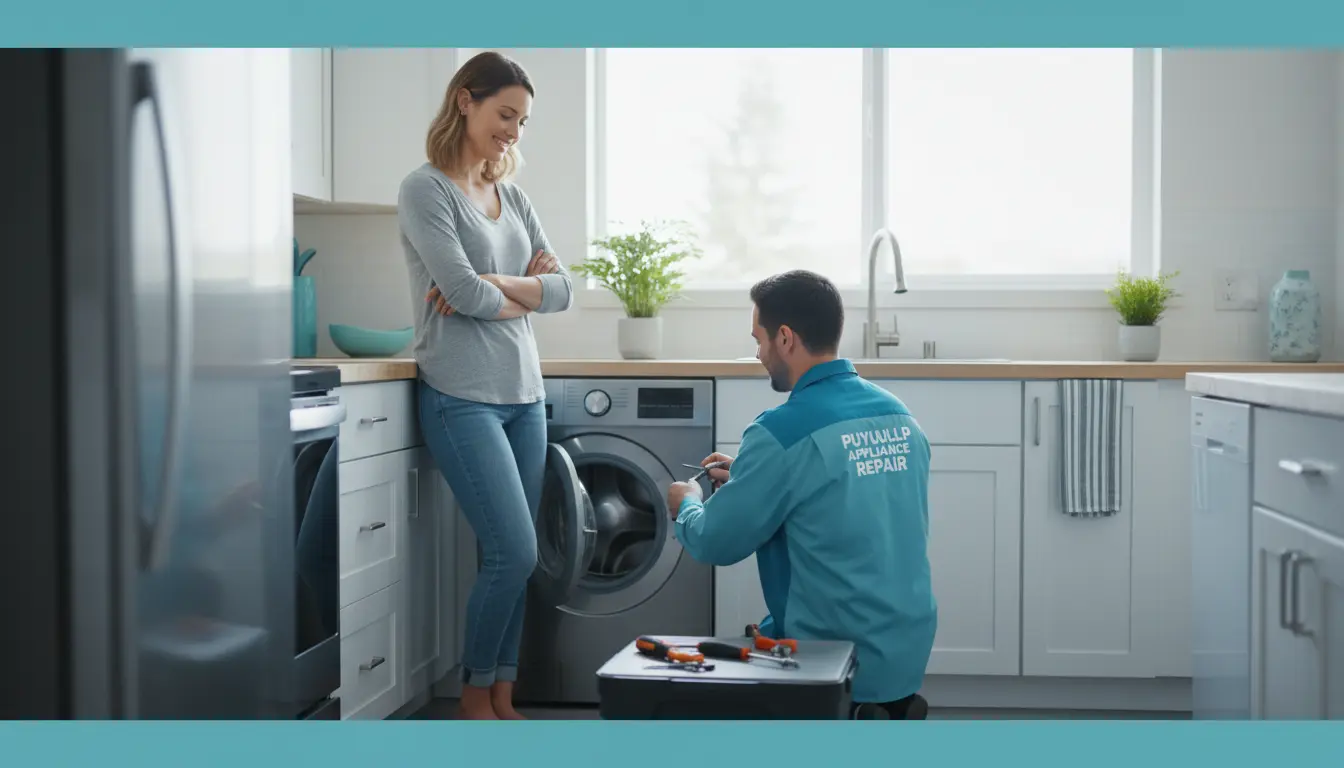
Puyallup’s unique climate — with persistent Pacific Northwest moisture, soft-to-moderate water profiles, and seasonal temperature swings — places unusual stress on household appliances. Moisture seeps into electronic housing seals, causing corrosion on control boards. Soft water, while gentle on skin, leaves mineral deposits that accumulate on heating elements and valves. Refrigerators and freezers work harder during the mild but humid summers, and dryers struggle to vent damp air efficiently. Without professional, factory-certified maintenance, these conditions accelerate wear and lead to premature failures. For homeowners who want to avoid costly breakdowns and unnecessary service calls, understanding the most common mistakes — and how to prevent them — is essential.
Why Puyallup’s Environment Demands Precision Appliance Care
Homeowners in Puyallup often underestimate the impact of local conditions on their appliances. The region’s high humidity, averaging over 70% for much of the year, creates a persistent threat to electronic components. Control boards, touchscreens, and wiring harnesses are vulnerable to moisture ingress, especially when seals around doors or panels degrade. A simple inspection of gaskets and housing seals during routine maintenance can prevent short circuits that require expensive board replacements.
Another factor is the water quality. Puyallup’s water supply, drawn from the Green River and local wells, has a moderate hardness level — typically between 4 and 7 grains per gallon. While not extremely hard, this still leads to scale accumulation in dishwashers, washing machines, and water heaters. Over time, scale buildup on heating elements reduces efficiency, increases energy consumption, and can cause thermal degradation that leads to element failure. For example, a dishwasher that takes longer to heat water or leaves spots on glassware is often suffering from scale accumulation on the heating element rather than a mechanical defect. Professional descaling and calibration can restore performance without the need for part replacement.
The Professional Diagnostic Workflow: What Happens When You Call an Expert
Certified technicians follow a systematic diagnostic process that goes far beyond visual inspection. Understanding this workflow can help homeowners appreciate why professional service is often the most cost-effective solution in the long run. The process begins with a thorough electrical safety check — verifying that the appliance is properly grounded and that there are no voltage fluctuations that could damage sensitive components.
Next, the technician performs a multi-meter inspection. Using a digital multimeter (DMM), they measure resistance across heating elements, thermistors, and compressor windings. For example, a refrigerator compressor should have a specific resistance between the common, start, and run terminals — typically 3 to 15 ohms depending on the model. A reading outside this range indicates a shorted or open winding, which requires compressor replacement. Similarly, ohm testing of the defrost thermostat and heater verifies the integrity of the defrost circuit, a common failure point in Puyallup’s humid climate.
For appliances with electronic control boards, technicians use diagnostic software or specialized tools to read error codes and log cycle data. This is especially important for modern dishwashers and washing machines, where symptoms like intermittent failure to start or irregular cycle times may be caused by a faulty control board rather than a mechanical issue. In Puyallup, moisture-related corrosion on board connectors is a frequent finding. The technician will clean contacts, apply dielectric grease, and test for proper voltage at the board’s output terminals.
Tools of the Trade
Professional technicians use a range of specialized tools that are not typically available to homeowners. These include digital multimeters with true RMS capability for accurate readings on inverter-driven compressors, clamp-on ammeters to measure compressor start-up current, and refrigerant manifold gauges for HVAC systems. For dishwashers and washing machines, they use leak detection kits, water pressure gauges, and diagnostic software that interfaces with the appliance’s electronic control module. Each tool serves a specific purpose: for example, a clamp-on ammeter can detect a compressor that is drawing excessive current during startup, indicating a failing start relay or a mechanical lockup. This kind of precision is what separates a professional repair from a guess-and-replace approach.
Professional Component-Level Repair vs. Complete Sub-Assembly Replacement
| Feature/Metric | Professional Component-Level Repair | Complete Sub-Assembly Replacement |
|---|---|---|
| Diagnostic Time | 45–60 minutes (includes component testing) | 15–30 minutes (limited to verifying sub-assembly failure) |
| Part Longevity | High (OEM components, matched to original spec) | Variable (depends on sub-assembly quality; often OEM) |
| Structural Cost | Lower (typically 30–50% less than sub-assembly replacement) | Higher (includes entire module, often with unnecessary parts) |
| Labor Time | 1–2 hours (includes component isolation and soldering/connections) | 30–60 minutes (plug-and-play replacement) |
| Warranty Coverage | Standard 90-day to 1-year on parts and labor | Often 90-day parts only, labor extra |
| Environmental Impact | Lower (replaces only failed component, less waste) | Higher (entire sub-assembly discarded) |
When a technician recommends component-level repair, it is because they have identified the exact failed part — a start relay, a heating element, a door switch, or a thermistor — and can replace it without replacing the entire control board or motor assembly. This approach is often more cost-effective and environmentally responsible. However, it requires advanced diagnostic skills and access to OEM parts. In Puyallup, many homeowners opt for sub-assembly replacement because it is faster, but they may end up paying more for parts that are not actually defective. The decision should be based on the specific appliance, the availability of parts, and the technician’s expertise.
Expert Insights: Advanced Diagnostic Tips for Puyallup Homeowners
Experienced technicians rely on specific diagnostic checks that often catch problems before they become catastrophic. One essential tip is to check voltage drops at the terminal block of major appliances like dryers and ranges. A poor connection or corroded terminal can cause intermittent power loss, leading to erratic behavior or component failure. Using a DMM, measure voltage between the terminal block and the appliance’s neutral bus bar while the appliance is under load. A drop of more than 3 volts indicates a resistance issue that needs to be addressed immediately.
Another common oversight is seasonal dryer vent maintenance. In Puyallup’s humid climate, lint buildup in dryer vents is accelerated by the moisture in the exhaust air. This not only reduces drying efficiency but also creates a significant fire hazard. Technicians recommend cleaning the vent from the dryer to the outside termination at least twice a year, and testing the thermal fuse and high-limit thermostat using a continuity scale. A dryer that shuts off before the cycle ends or takes multiple cycles to dry a load is often suffering from a clogged vent, not a mechanical failure.
Common Mistakes Homeowners Make
Overloading laundry drums is a frequent error that leads to structural bearing failure. Washing machines are designed to handle a specific load weight; exceeding it causes the drum to become unbalanced, putting excessive stress on the bearings and suspension springs. This can result in loud noises during spin cycles, leaks, and eventual drum lockup. In Puyallup, where many homes have older washing machines, the problem is compounded by the fact that bearings are often not replaceable without replacing the entire outer tub — a costly repair.
Another mistake is using chemical drain cleaners in dishwashers. These harsh chemicals can destroy the rubber seals in the drain pump and the sump gasket, causing leaks that may flood the kitchen floor. Instead, use a vinegar and baking soda flush or a professional descaling service. For dishwashers, checking the quick DIY fixes for leaky dishwashers in Puyallup can help homeowners address minor issues before they become major.
Ignoring minor refrigerator clicking cycles is a third mistake. A clicking sound from the refrigerator often indicates the compressor relay is cycling on and off due to a failing start relay or a thermal overload. If ignored, the relay can burn out completely, leading to a no-cool condition. In many cases, replacing the start relay and overload protector is a simple fix that costs less than $50. However, if the compressor is already damaged, the repair becomes much more expensive. Recognizing these early signs is crucial for avoiding the Puyallup’s most common appliance problems this year.
Pricing for Professional Appliance Repair in Puyallup
- Standard diagnostic trip fee: Most professional services charge a flat fee between $65 and $95 for a technician to visit your home and perform a comprehensive diagnostic assessment. This fee is typically applied toward the cost of the repair if you proceed with the service.
- Tiered repair rates based on appliance complexity: Simple repairs such as replacing a door switch or a belt may cost $100–$150 plus parts. More complex jobs like sealed system repairs (compressor, evaporator, condenser) on refrigerators or freezers range from $350 to $700, depending on the refrigerant type and accessibility.
- Flat-rate structural pricing: For specific tasks like heating element replacement in an oven or dryer, many technicians offer a flat rate that includes labor and the OEM part. This can range from $150 to $300 for a heating element, versus $200–$400 for a complete sub-assembly replacement.
Safety and Standards: What Every Homeowner Should Know
Professional appliance repair is governed by strict safety standards and certifications that protect both the technician and the homeowner. For refrigerators and freezers, the EPA Section 608 certification is required for anyone who handles refrigerants. This certification ensures that the technician is trained to recover, recycle, and properly dispose of refrigerants, preventing environmental damage and ensuring compliance with federal regulations. Attempting to repair a sealed system without this certification is illegal and dangerous.
Electrical safety is another critical area. Technicians follow OSHA standards for lockout/tagout procedures when working on high-voltage appliances, and they always verify that the appliance is properly grounded before beginning any work. A simple continuity test between the appliance chassis and a known ground can prevent severe electric shock. Using factory-authorized OEM replacement parts is also essential for maintaining warranty coverage and ensuring the appliance operates within its designed parameters. Aftermarket parts may be cheaper, but they often lack the exact tolerances needed for safe operation, leading to component failure or fire hazards.
For dryers, cleaning the vent system and checking for lint buildup is not just a performance issue—it is a fire safety requirement. According to the National Fire Protection Association, failure to clean dryer vents is the leading cause of dryer fires. In Puyallup, where humidity can cause more lint to stick to vent walls, professional cleaning every six months is recommended. Homeowners can also perform a simple test: if the dryer does not seem to be drying clothes as quickly as before, check the vent airflow by holding a hand near the outside vent opening while the dryer is running. A weak airflow indicates a clog that needs professional attention.
Frequently Asked Questions About Appliance Repair in Puyallup
Why does my refrigerator run constantly in the summer?
In Puyallup, summer temperatures can cause the refrigerator’s condenser coils to become less efficient at dissipating heat. If the coils are dirty or if the condenser fan is failing, the compressor must run longer to maintain the set temperature. This increases wear on the compressor and can lead to burnout. Cleaning the coils and checking the fan motor are simple preventive measures. If the issue persists, a technician should measure the compressor’s start-up current and check the relay for signs of thermal degradation.
Can I use a chemical drain cleaner to unclog my dishwasher?
No. Chemical drain cleaners contain harsh acids or alkalis that can damage the rubber seals, drain pump, and sump components in a dishwasher. These chemicals are designed for metal pipes, not plastic or rubber parts found in modern appliances. Instead, remove the drain basket and clean out any food debris manually. If the drain is still slow, use a vinegar and baking soda flush or call a professional who can inspect the drain hose and pump for blockages.
How often should I clean my dryer vent in Puyallup?
Given the high humidity in the Pacific Northwest, we recommend professional dryer vent cleaning at least twice a year. Lint buildup in the vent reduces airflow, increases drying time, and poses a fire risk. Homeowners should also clean the lint filter after every load. If your dryer is taking longer than usual to dry clothes, or if the clothes come out hotter than normal, the vent is likely clogged. A technician can measure airflow at the vent termination and test the thermal fuse for continuity.
What does it mean if my washing machine makes a loud banging noise during the spin cycle?
A loud banging noise is often a sign that the drum is unbalanced due to an overloaded load or a worn-out suspension spring. Overloading the washing machine puts excessive stress on the bearings and can cause them to fail prematurely. If the noise persists after redistributing the load, the bearings may be damaged. In many front-load machines, replacing the bearings requires disassembling the entire outer drum, which is a labor-intensive repair. It is more cost-effective to avoid overloading and to have the machine inspected at the first sign of unusual noise.
Is it worth repairing an older appliance, or should I replace it?
This depends on the age of the appliance, the cost of the repair, and the availability of parts. As a rule of thumb, if the repair cost is more than 50% of the cost of a new appliance, replacement is usually the better option. However, for high-end appliances or those with a long expected lifespan, a component-level repair can be very cost-effective. A technician can provide a detailed assessment of the appliance’s condition and the expected longevity of the repaired component. In Puyallup, many older appliances still perform well with proper maintenance, especially if they are built with durable components.
Professional Appliance Care in Puyallup
Maintaining your home’s electromechanical systems is not just about convenience—it is about protecting your investment and ensuring the safety of your household. The unique environmental conditions in Puyallup demand a proactive approach to appliance care. By avoiding common mistakes such as ignoring early warning signs, using DIY fixes that cause more harm, and neglecting routine maintenance, homeowners can extend the life of their appliances and reduce the likelihood of emergency repairs.
Puyallup Appliance Repair is the most practical, highly-trained, and reliable service network in the area. Our technicians are factory-certified, carry the necessary certifications (EPA Section 608, NASTeC, OSHA), and use only OEM parts. We understand the specific challenges of Puyallup’s climate and water quality, and we tailor our diagnostic and repair processes accordingly. Whether you need a simple fix or a complex sealed system repair, we provide transparent pricing, thorough diagnostics, and long-lasting results. Contact us today to schedule a service visit and keep your appliances running efficiently for years to come.