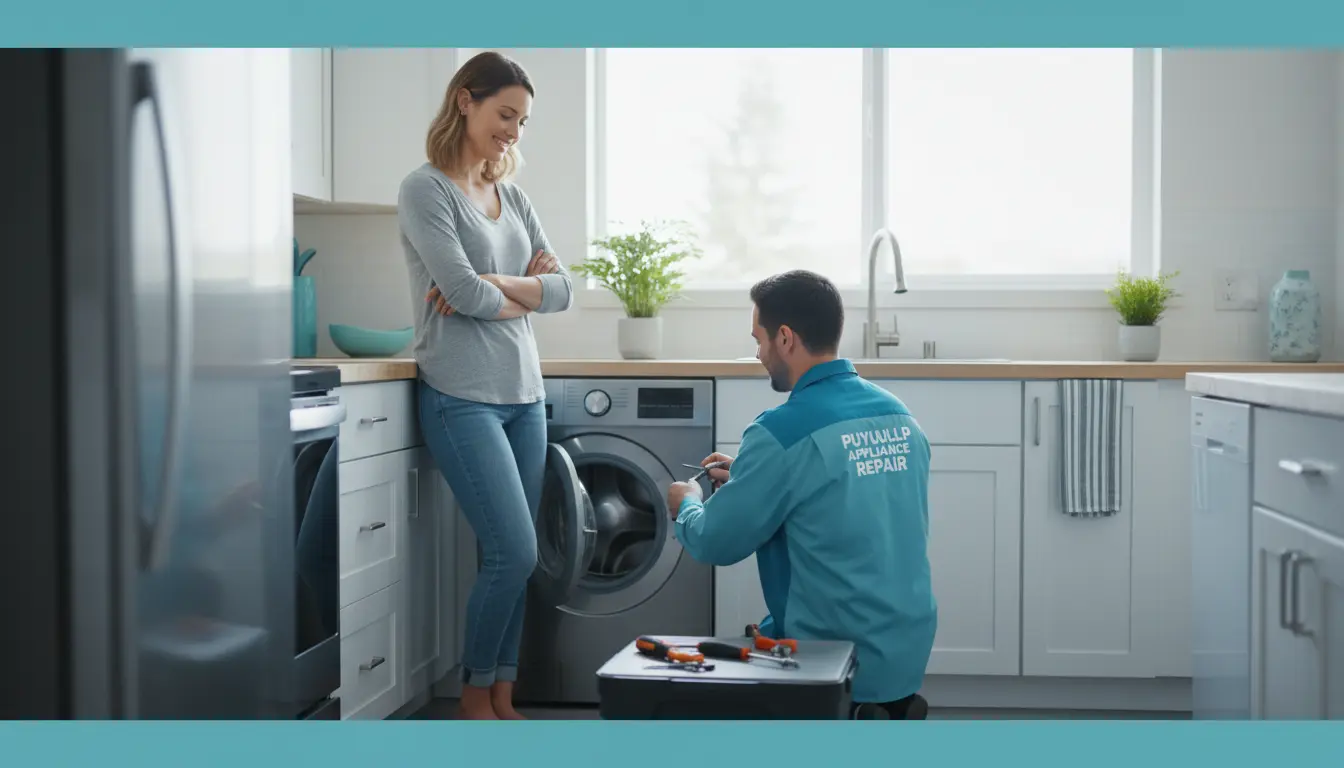
Appliance repair in Puyallup is not a one-size-fits-all service. The region’s soft-to-moderate water profile, while beneficial for pipes, contributes to scale accumulation on heating elements in dishwashers and washing machines. Seasonal temperature swings force refrigeration systems to work harder, increasing thermal degradation of seals and compressor relays. And the constant humidity—especially during the nine months of rain—corrodes circuit board connectors and accelerates the failure of microswitches in dryers. For the homeowner, these factors mean that a simple component failure may be a symptom of a deeper environmental stress. A professional technician must account for these variables when diagnosing and pricing repairs. In 2026, the cost of restoring a malfunctioning appliance in Puyallup will depend on the specific interplay between the appliance’s age, the local climate, and the availability of OEM parts.
The Technical Process Behind Professional Diagnostics in Puyallup
When a certified technician arrives at a home in Puyallup, the diagnostic process begins before any tool touches the appliance. The technician will first interview the homeowner about the failure pattern—frequency of clicking sounds, error codes, recent water usage, and any electrical surges. This initial step is critical because it narrows the potential failure modes. For example, a refrigerator that cycles on and off rapidly may indicate a failing start relay, but if the homeowner also mentions a flickering light in the kitchen during the previous storm, the technician may suspect a voltage drop that damaged the control board. Once the history is documented, the technician proceeds to a systematic electrical and mechanical inspection.
Using a digital multi-meter set to resistance mode, the technician performs ohm testing on key components. For a refrigerator, that includes the compressor windings, the start relay, the overload protector, and the evaporator fan motor. The expected resistance values for a three-phase compressor winding, for instance, typically range from 3 to 15 ohms, depending on the model. A reading outside this range indicates a shorted or open winding, which often requires a sealed system repair. In Puyallup, where humidity can cause corrosion on the terminals, the technician may also use a clamp-on ammeter to measure the actual current draw during startup. This reveals whether the compressor is mechanically locked or electrically compromised. The technician then performs continuity verification on all switches and thermostats, checking for breaks in the circuit that could prevent the appliance from receiving power to its critical subsystems.
Data Comparison: Professional Component-Level Repair vs. Complete Sub-Assembly Replacement
One of the most critical decisions in appliance repair is whether to replace a single failed component or to swap out the entire sub-assembly. The table below compares these two approaches for a typical Puyallup refrigerator with a failed start relay and a compromised control board.
| Feature / Metric | Professional Component-Level Repair | Complete Sub-Assembly Replacement |
|---|---|---|
| Diagnostic Time | 45–60 minutes (precise isolation of the defective relay and board) | 30–45 minutes (focused on verifying full assembly compatibility) |
| Part Longevity | Original relay life: 5–7 years; control board component: 8–10 years | New sub-assembly (relay + board): 10–12 years |
| Structural Cost | $150–$250 (relay) + $180–$300 (control board repair) + $120 diagnostic fee | $400–$700 (new assembly) + $120 diagnostic fee + $150–$200 labor |
| Warranty Coverage | 90 days on repaired component | 1 year on entire assembly |
| Moisture Vulnerability | Higher risk of corrosion on repaired board if not re-sealed properly | Lower risk due to factory encapsulation |
| Environmental Impact | Lower waste (only failed component replaced) | Higher waste (entire assembly discarded) |
Expert Insights for Puyallup Homeowners
Advanced diagnostic tips can save homeowners time and money, but only when applied correctly. One of the most overlooked checks is the voltage drop at the terminal block. In older Puyallup homes, especially those in the historic downtown area, wiring can be undersized or degraded. A technician should measure the voltage at the appliance while it is under load—during a heating cycle in a dryer or a defrost cycle in a refrigerator. A drop of more than 5% from the nominal 120 volts indicates a compromised circuit, and the appliance will operate inefficiently, accelerating wear on motors and compressors. Seasonal dryer vent maintenance is another critical practice. In Puyallup’s damp climate, lint combines with moisture to form a dense, adhesive layer inside the vent. This not only reduces drying efficiency but also creates a fire hazard. The technician should perform a static pressure test on the vent system, or simply measure the airflow at the exterior vent with an anemometer. A reading below 200 feet per minute suggests a blockage.
Another common mistake is ignoring the thermal fuse in a dryer. Homeowners often assume the dryer has stopped heating because of a failed element, but the thermal fuse is a sacrificial device that opens when the temperature exceeds safe limits. A technician should test the fuse using the resistance scale on a multi-meter. If the fuse is open, the cause may be a clogged vent, not a failed element. Replacing the element without addressing the vent blockage will lead to a repeat failure. Homeowners also frequently overload washing machines, especially those with large capacity drums. Overloading can cause structural bearing failure, where the drum wobbles and eventually damages the suspension springs and the tub seal. The repair cost for a bearing replacement can exceed $500, whereas proper loading habits can prevent the issue entirely.
Pricing Structures for Puyallup Appliance Repairs
Understanding the cost of appliance repair in Puyallup requires a breakdown of the typical pricing models used by professional services. Most certified companies charge a flat diagnostic fee, which covers the initial visit and the inspection. This fee ranges from $75 to $130, depending on the complexity of the appliance and the time of day. After diagnosis, the repair cost is usually quoted as a tiered rate based on the appliance’s complexity and the specific repair required.
- Standard diagnostic trip fee: $85–$120 for most appliances, including refrigerators, washers, dryers, and dishwashers. This fee is often waived if the homeowner proceeds with the repair.
- Tiered repair rates: For simple tasks like replacing a start relay, thermostat, or door switch, the labor cost is typically $100–$180. Moderate repairs, such as replacing a heating element or a pump motor, range from $150 to $250. Complex sealed system repairs (refrigerant leak repair, compressor replacement) can cost $400–$900, including refrigerant recovery and recharging under EPA guidelines.
- Flat-rate structural pricing: Some repairs, such as complete control board replacement or major wiring harness repairs, are quoted at a flat rate that includes diagnostic time, parts, and labor. For a refrigerator control board, the flat rate averages $350–$500. For a dishwasher main board, $300–$450.
Safety Standards and Certifications
Every appliance repair in Puyallup must adhere to rigorous safety standards to protect both the homeowner and the technician. The most critical certification is the EPA Section 608 certification for technicians who handle refrigerants. This certification is mandatory for any repair involving the sealed system of a refrigerator, freezer, or air conditioner. A technician without this certification cannot legally buy refrigerant or perform repairs that require opening the refrigerant loop. In Puyallup, where many homes have older refrigerators with R-12 or R-134a, proper recovery and disposal of these refrigerants is essential to avoid environmental fines and to ensure the system is recharged with the correct amount of the appropriate refrigerant.
Electrical safety grounding protocols are equally important. The technician must verify that the appliance is properly grounded using a three-wire receptacle. In older Puyallup homes, two-prong outlets are still common, and a technician must use a ground fault circuit interrupter (GFCI) adapter or advise the homeowner to upgrade the outlet. Failure to ground can result in high-voltage electrical short circuits that damage the appliance and pose a risk of electric shock. Additionally, the use of factory-authorized OEM replacement parts ensures that the appliance meets the manufacturer’s specifications for electrical load, thermal limits, and mechanical fit. Aftermarket parts may save money upfront but often have different tolerances, leading to premature failure or even fire hazards. For example, a non-OEM dryer heating element may have a slightly lower resistance, causing it to overheat and melt the housing. The technician should always document the use of OEM parts on the invoice to maintain warranty compliance.
Frequently Asked Questions About Appliance Repair Costs and Diagnostics
Why is my refrigerator making a clicking sound but not cooling?
The clicking sound is typically the start relay attempting to engage the compressor. When the relay fails, it may click repeatedly without the compressor starting. The relay is a small electronic component that can be tested with a multi-meter. If the relay is open or shorted, it must be replaced. However, the clicking can also indicate a mechanical lockup of the compressor, where the internal mechanism is seized. A technician can verify by measuring the resistance of the compressor windings. If all windings have continuity, the compressor is likely electrically sound, and the relay is the culprit. If the windings are open or shorted to ground, the compressor must be replaced, which is a sealed system repair costing $400–$900.
How much does it cost to repair a washing machine that won’t spin?
The cost depends on the root cause. If the lid switch is faulty, the repair is straightforward—replace the switch for $100–$150. If the drive belt is broken, the part costs $20–$40, and labor adds $80–$120. A more serious issue is a failed motor control board, which can cost $200–$400 for the board plus $150–$250 labor. In Puyallup, washing machine spin failures are often linked to overloading, which strains the bearings and suspension. A bearing replacement can cost $300–$500 because it requires disassembling the entire drum. The technician should first perform a continuity check on the lid switch and the motor windings, then inspect the belt for wear. If the motor hums but the drum doesn’t turn, the capacitor may be weak—a $30 part.
Is it worth repairing an older dishwasher, or should I replace it?
This depends on the age of the unit and the cost of the repair. For a dishwasher that is 8–10 years old, a repair costing less than 50% of a new unit’s price is usually worth it. Common repairs include replacing a leaking pump seal ($150–$250), a failed heating element ($100–$180), or a control board ($250–$400). However, if the dishwasher has multiple failures or if the tub is rusted, replacement is more economical. In Puyallup, scale buildup is a common cause of heating element failure. A technician can perform a descaling service for $80–$120, which may extend the life of the element by a year or two. If the dishwasher is less than 5 years old and the repair is under $300, it is almost always worth repairing, especially if the unit is a high-end model.
What should I do if my dryer is not heating?
First, check the thermal fuse. It is a small white component usually located on the blower housing. If it is blown (open circuit), the dryer will tumble but not heat. The fuse blows when the vent is clogged, causing excessive heat buildup. Clean the vent and replace the fuse (cost $10–$20). If the fuse is intact, test the heating element. For electric dryers, measure the resistance across the element; it should be between 10 and 20 ohms. If it is open, replace the element ($30–$60). For gas dryers, check the ignitor and gas valve coils. Ignitor failure is common—the ignitor glows but does not ignite the gas, or it glows dimly. A new ignitor costs $15–$30. In Puyallup, moisture in the vent can cause the thermal fuse to blow repeatedly if the vent is not cleaned. A professional dryer vent cleaning service costs $100–$150 and is recommended every 1–2 years.
How do I know if my refrigerator’s control board is faulty?
Control board failures often manifest as intermittent operation, error codes on the display, or the refrigerator running but not cooling. A technician can test the board by measuring the voltage output to the compressor and fans. If the board is receiving correct input voltage (120V) but not sending proper output, it is likely defective. Sometimes, a visual inspection reveals burnt components or bulging capacitors. However, some control boards can be repaired by replacing individual capacitors or relays, which is a component-level repair. This is less expensive than a full board replacement. In Puyallup, moisture-induced corrosion on the board’s solder joints is a common cause. A technician can clean the board with isopropyl alcohol and apply a conformal coating to prevent future corrosion. This repair costs $120–$200, compared to $300–$500 for a new board.
What is the average lifespan of a dishwasher in Puyallup, and how can I extend it?
The average lifespan of a dishwasher is 9–12 years, but in Puyallup’s climate, scale accumulation can reduce it to 7–9 years. To extend the life, use a rinse aid to improve drying and reduce water spots, which also lowers mineral buildup. Run a cleaning cycle with a dishwasher cleaner every three months to remove scale and grease. Check the door gasket annually for cracks; replace it if necessary ($15–$30). Also, ensure the water inlet temperature is between 120°F and 140°F. Too hot can damage the seals, too cold reduces cleaning effectiveness. A professional descaling calibration service every two years can help maintain the heating element’s efficiency.
Why does my washing machine smell musty, and how do I fix it?
Musty odors are caused by mold and mildew growing in the drum, rubber gasket, and drain hose. In Puyallup’s humid climate, this is a common issue. The solution is to run a cleaning cycle with a washing machine cleaner or a cup of white vinegar. After each wash, leave the door open for at least an hour to allow the interior to dry. Clean the rubber gasket with a bleach solution every month. If the smell persists, the drain hose may be clogged with lint and soap residue. Disconnect the hose and flush it with hot water. A professional deep cleaning service costs $100–$150 and includes cleaning the pump filter and the drum.
Professional Appliance Care in Puyallup
Maintaining the efficiency and longevity of your home’s electromechanical systems requires a combination of proactive care and professional intervention. The unique conditions of Puyallup—moisture, moderate water hardness, and seasonal temperature swings—demand a technician who understands how these factors affect every component from the control board to the compressor. By choosing a certified, factory-authorized service provider, homeowners ensure that each repair is performed with precision, using OEM parts and following industry-standard safety protocols. Whether you are dealing with a refrigerator that won’t cool, a washing machine that won’t spin, or a dishwasher that leaks, the right diagnostic approach can save you money and extend the life of your appliances.