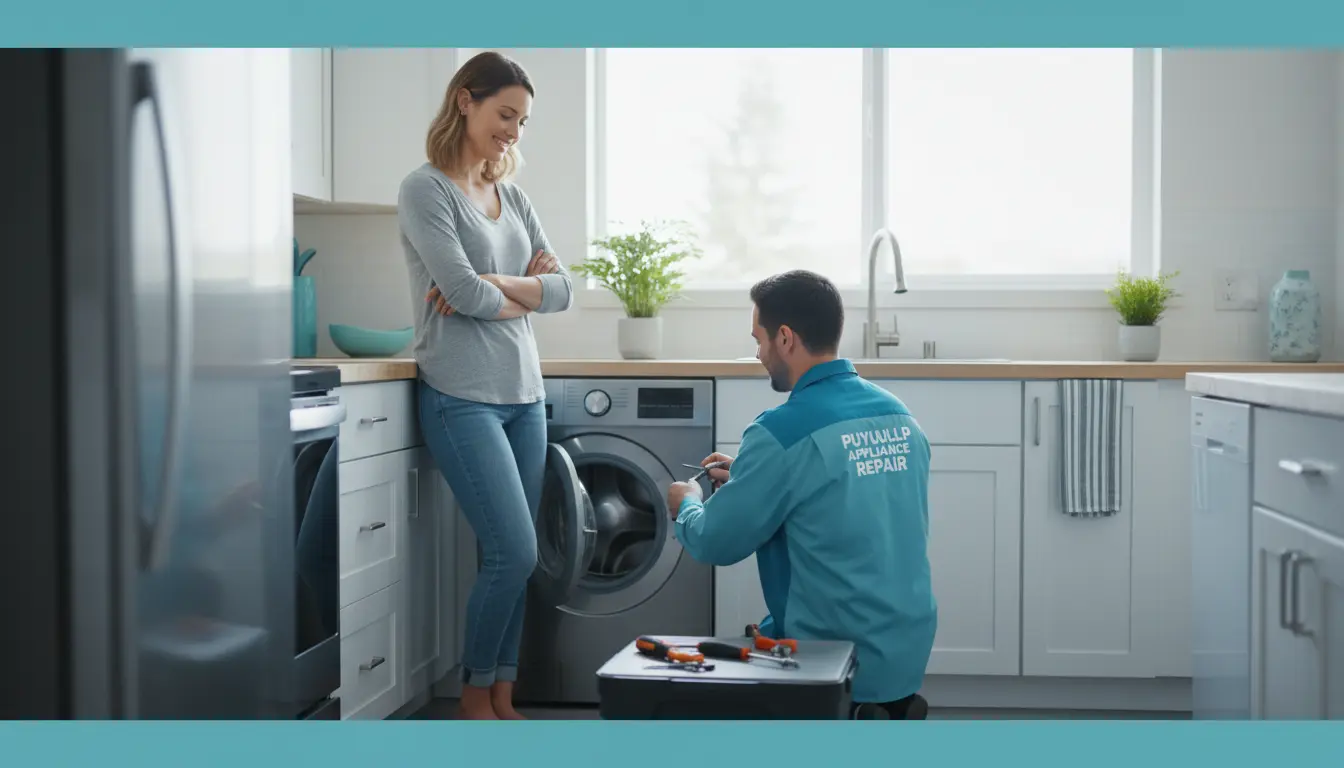
An oven repair problem is any electromechanical or electronic failure that prevents the appliance from delivering consistent, safe thermal output for cooking or baking. This definition excludes routine cleaning issues, such as burnt-on food residue or mild odor, which are not true repair problems but maintenance concerns. For homeowners in Puyallup, Washington, where seasonal humidity often exceeds 80% and local water contains moderate mineral content, the line between a simple wear item and a critical failure can blur quickly. Moisture seeps into control board housings, and calcium deposits build up on heating elements, turning what might be a minor issue elsewhere into a component-killing event. Understanding the difference between a blown thermal fuse and a failed electronic control board is the first step toward making an informed repair decision rather than an expensive replacement.
Puyallup’s unique climate and aging housing stock compound the stress on ovens. Many homes built between the 1960s and 1990s still have original or near-original appliances, and their electrical systems may not deliver the stable voltage modern ovens require. Frequent voltage sags during winter storms can damage electronic ignition modules and clock-timer boards. Professional diagnostics from a certified technician—like those at South Hill VS Major Appliance Repair—are essential to isolate the root cause rather than chasing symptoms. A proper repair workflow begins with a systematic inspection of power delivery, sensor accuracy, and thermal integrity before any component is replaced.
Professional Oven Diagnostics: Step-by-Step Workflow for Puyallup Homes
A certified technician follows a precise sequence when diagnosing an oven complaint. The first tool deployed is a digital multimeter set to AC voltage mode. The technician checks the outlet or junction box for a stable 240-volt supply (or 120 volts for gas ovens with electric ignition) under load. Voltage drops exceeding 10% indicate a wiring or breaker issue that must be resolved before any oven component testing begins. Once power delivery is confirmed, the technician moves to the control board. Using a clamp-on ammeter, they measure current draw at the main relay outputs while the oven is commanded to heat. If the ammeter shows no current despite the relay clicking, the relay contact points may be carbonized or the board may have a cracked solder joint.
Next, continuity verification is performed on heating elements, thermal sensors, and safety thermostats. For bake and broil elements, resistance readings should fall within a range specified by the manufacturer—typically 20 to 40 ohms for a standard 240-volt element. A reading outside that range indicates thermal degradation or an open circuit. The technician also checks the oven temperature sensor (RTD) for correct resistance at ambient temperature (around 1080 ohms at 70°F) and compares it to a known temperature reference using an oven thermometer. In Puyallup, moisture-related corrosion on sensor terminals is common; a simple cleaning and dielectric grease application can restore accurate readings without replacing the sensor. Finally, the technician inspects sealed system components in gas ovens: the gas valve solenoid coils, igniter, and flame sensor. Using manifold gauges and an ohmmeter, they confirm gas flow and spark or glow-bar operation. This entire process takes 45 to 75 minutes and yields a definitive diagnosis rather than a guess.
Data Comparison: Component-Level Repair vs. Complete Sub-Assembly Replacement
When a fault is isolated to a single part—such as a bake element, thermostat, or igniter—homeowners often face a choice between repairing just that component or replacing the entire sub-assembly (e.g., the full control board or burner box). The table below outlines the key trade-offs based on current NASTeC benchmarks and local service data from Puyallup.
| Feature/Metric | Professional Component-Level Repair | Complete Sub-Assembly Replacement |
|---|---|---|
| Diagnostic Time | 45–60 minutes (precise isolation) | 20–30 minutes (swap entire unit) |
| Part Longevity | 3–7 years (depends on OEM quality) | 5–10 years (new assembly, but often higher failure rate from integrated electronics) |
| Structural Cost | $80–$200 (part only) plus $120–$180 labor | $250–$600 (assembly) plus $100–$150 labor |
Source: NASTeC Core Appliance Service Reference Standard, 2023 Edition.
Component-level repair offers lower upfront cost and retains the original robust mechanical structure of the oven, but it requires skilled soldering or wiring work. Sub-assembly replacement is faster and eliminates the need for micro-soldering, but it often introduces new failure points because the replacement board may have different firmware or component tolerances. For Puyallup homeowners with older models, component repair is usually more sustainable, especially when the surrounding chassis and insulation remain sound.
Expert Insights: Advanced Diagnostic Tips for Oven Reliability
Tip 1: Voltage Drop Testing at the Terminal Block
Many intermittent oven problems—like the oven heating then stopping randomly—are caused not by the oven itself but by a loose neutral connection at the main terminal block. A technician should perform a voltage drop test under full load (oven set to 500°F). If the voltage between neutral and ground exceeds 2 volts AC, the neutral connection is compromised. This is especially common in Puyallup homes with aluminum branch wiring installed in the 1970s. Tightening the terminal block screws and applying an anti-oxidant compound often resolves the issue permanently.
Tip 2: Testing Thermal Fuses Using Resistance Scales
Thermal fuses are one-shot safety devices that blow when the oven overheats. Homeowners often replace them without checking why they blew. A blown fuse measured with a multimeter in resistance mode will read infinite ohms. But the real diagnostic value is in confirming that the oven’s convection fan, cooling fan, and door switch all operate correctly before installing a new fuse. If the fan motor bearings are failing due to humidity (common in Puyallup kitchens), the oven will overheat again and blow the new fuse. A simple amp draw test on the fan motor tells the technician whether it needs replacement.
Tip 3: Seasonal Maintenance for Gas Oven Igniters
Gas oven igniters are susceptible to soot buildup from incomplete combustion, especially when the gas pressure is slightly low. In Puyallup, winter months see increased use of oven for heating (never recommended, but it happens), leading to carbon deposits. A technician can clean the igniter tip with isopropyl alcohol and a soft brush, then verify the igniter draws at least 3.2 amps (for silicon nitride types) or 2.5 amps (for silicon carbide types) during the warm-up cycle. If the amp draw is below spec, the igniter is weak and should be replaced before it fails mid-cook.
Common Homeowner Mistakes That Worsen Oven Problems
One frequent mistake is using the self-cleaning cycle too often. While convenient, the self-clean mode subjects the oven to temperatures exceeding 800°F, which can warp thin sheet metal, damage door gaskets, and cause thermal fuses to blow if the door lock mechanism fails. In Puyallup, where older ovens may have weakened seals from years of humidity, running a self-clean cycle can be the final straw. Instead, manual cleaning with a non-abrasive cleaner and a soft sponge extends the oven’s life significantly.
Another misstep is ignoring the sound of repeated clicking from a gas oven igniter. Many homeowners assume the oven is simply “trying to light” and wait minutes before turning it off. In reality, a clicking igniter that fails to ignite after 60 seconds indicates a flame sensor or gas valve issue. Continuing to click wastes gas and can cause a dangerous gas accumulation. The correct action is to turn off the oven, open a window, and call a technician. Replacing a $30 igniter early prevents a $200 gas valve replacement later.
Pricing Structure for Oven Repair in Puyallup
Understanding what you pay for when you call a professional helps avoid sticker shock. Based on local market rates and the complexity of modern ovens, here is a realistic breakdown:
- Standard Diagnostic Trip Fee: $75–$125. This covers the technician’s time to travel to your home and perform the initial inspection. The fee is typically waived if you proceed with the repair through the same company.
- Tiered Repair Rates: $100–$180 per hour for labor. Gas oven repairs (igniters, gas valves) tend toward the lower end because they are straightforward mechanical swaps. Electric oven repairs involving control boards or sealed systems (heating elements, temperature sensors) cost more due to the need for precision soldering or refrigerant handling.
- Flat-Rate Structural Pricing: Some tasks, like replacing a bake element ($120–$200 total) or a control board ($250–$450 total), are quoted as flat rates. This covers part and labor, giving you a predictable cost.
Three factors influence the final bill: OEM part sourcing—genuine manufacturer parts cost 20–40% more than generic substitutes but ensure fit and longevity; accessibility—a wall oven built into a tight cabinet requires more disassembly than a freestanding range; and brand complexity—luxury brands like Wolf, Viking, or Thermador use proprietary components that are harder to source and often require specialized software to calibrate.
Safety Standards and Certifications That Protect Puyallup Homeowners
When hiring an oven repair technician, you should verify that they hold or follow these industry standards. EPA Section 608 Certification is required for anyone handling refrigerants in sealed-system repairs (e.g., convection ovens with steam generators). NASTeC (National Appliance Service Technician Certification) demonstrates that the technician has passed a rigorous exam covering electrical theory, gas safety, and diagnostic procedures. OSHA lockout/tagout protocols must be observed when working on live circuits—this prevents accidental energization during repairs.
Using factory-authorized OEM replacement parts is not a luxury; it is a safety requirement. Third-party knock-off heating elements may have different wattage ratings, leading to overheating or short cycling. Door gaskets made from inferior silicone can degrade quickly in Puyallup’s humid climate, creating a fire hazard if grease accumulates. A certified technician will always source OEM parts and document the repair per the manufacturer’s service manual, preserving your appliance warranty and your home insurance coverage.
Frequently Asked Questions About Oven Repair
Why is my oven not heating evenly?
Uneven heating usually points to a faulty oven temperature sensor or a worn-out heating element. The sensor (RTD) sends temperature readings to the control board, which modulates power to the elements. If the sensor is out of calibration by even 10%, the oven will cycle incorrectly. A technician can test the sensor’s resistance at room temperature and compare it to the manufacturer’s chart. Replacing a sensor costs around $50–$80 for the part plus labor. Another possibility is a failing convection fan motor—if the fan blade is loose or the motor bearings are worn, heat distribution becomes uneven. This is more common in Puyallup homes where moisture causes bearing corrosion.
What does it mean when the oven clicks but doesn’t light?
That clicking sound is the igniter sparking or the glow-bar heating up. If the oven fails to light, the most likely culprit is a weak or failed igniter. A gas oven igniter must draw a specific amount of current (usually 3.0–3.5 amps) to open the gas valve. Over time, igniters lose resistance and cannot draw enough current. When this happens, the gas valve never opens, so you hear clicking (or see a glow) but no flame. A technician can test the igniter’s amperage with a clamp meter. Replacing an igniter is a straightforward repair costing $150–$250.
How often should I replace the oven door gasket?
Door gaskets should be inspected every six months and replaced if they show cracks, flattening, or magnetic loss (for magnetic seal types). In Puyallup, the high humidity accelerates the breakdown of the silicone or fiberglass material. A leaking gasket wastes energy, causes the oven to work harder, and can lead to overheating of the electronic components behind the control panel. Replacement gaskets cost $20–$60 and installation takes about 30 minutes.
Is it worth repairing an oven that is over 15 years old?
It depends on the specific problem and the brand. For a major component failure like a control board ($300–$500) on a 15-year-old oven, the repair cost may approach half the price of a new mid-range oven. However, if the oven is a high-end model with a robust build, replacing a $100 heating element can extend its life for several more years. A technician can give you a cost-to-value analysis. Also consider energy efficiency: older ovens lack modern insulation and may cost more to run. For Puyallup homeowners, we often recommend repair if the oven is less than 10 years old and the repair cost is under 40% of a comparable new unit.
Professional Appliance Care in Puyallup
Maintaining an efficient, safe oven requires more than waiting until it breaks. Routine inspections, cleaning, and timely repairs prevent small issues from escalating into costly replacements. For homeowners in Puyallup, the combination of moisture, mineral buildup, and aging electrical infrastructure makes professional care especially valuable. The technicians at South Hill VS Major Appliance Repair bring factory-level training, proper diagnostic tools, and a deep understanding of how local conditions affect appliance longevity. Whether you need a simple igniter replacement or a complex control board diagnosis, relying on certified experts ensures the job is done right the first time.
If you’re experiencing any of the problems described above, don’t wait until a minor click becomes a major failure. Contact Puyallup Appliance Repair today to schedule a diagnostic visit. Our team serves all neighborhoods, from Downtown Puyallup to South Hill, and beyond. We stand behind our work with a satisfaction guarantee and a commitment to using only OEM parts. Keep your kitchen running smoothly—call us now.