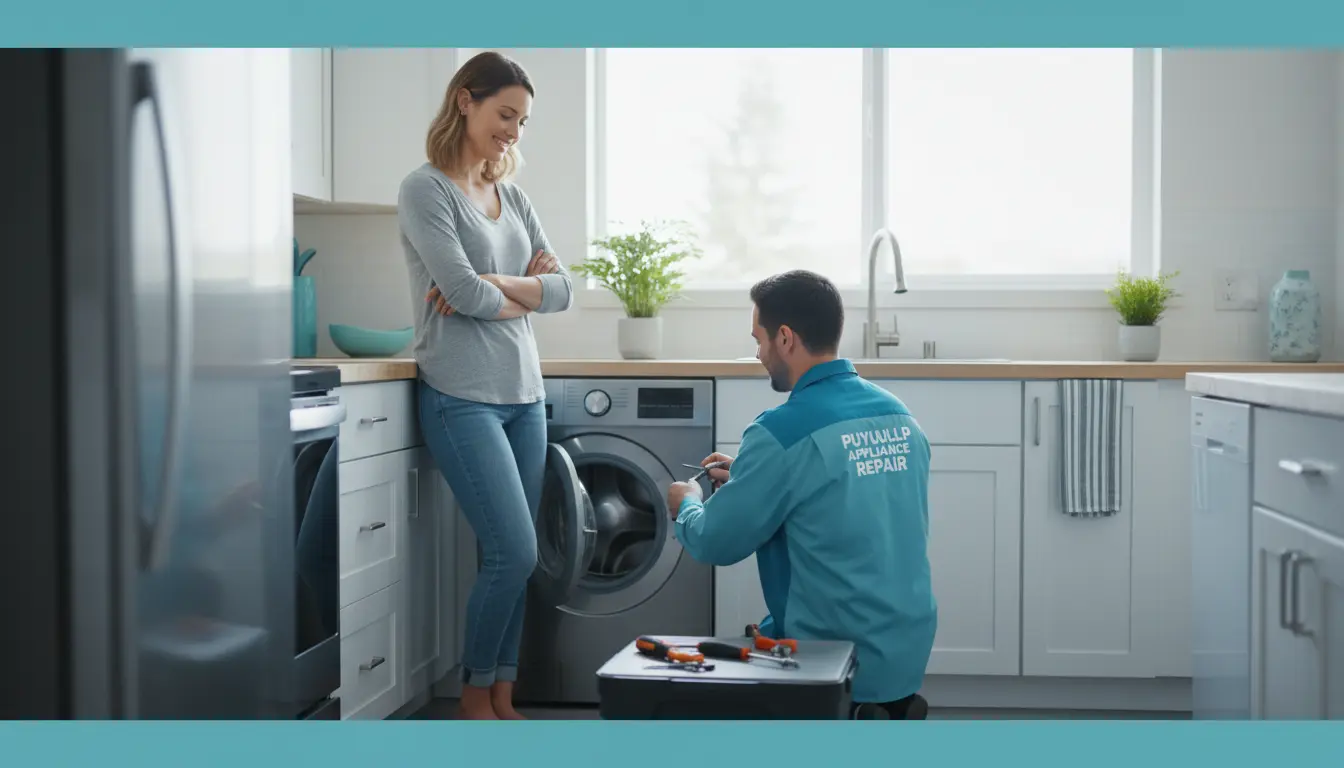
Every year, homeowners in Puyallup collectively lose thousands of dollars to a single, preventable mistake: waiting too long to call for a professional diagnosis on a struggling appliance. What begins as a minor inconvenience—a refrigerator that runs a bit louder, a dishwasher that leaves dishes damp, a dryer that takes two cycles—quietly escalates into a major failure. The cost of a simple component repair, often under $250, transforms into a $700+ bill for a full sub-assembly replacement or an entirely new machine. This pattern is not just anecdotal; it reflects the real appliance repair statistics and homeowner trends in Puyallup (2026), which show a clear shift toward reactive, rather than proactive, maintenance. The consequence is a higher rate of premature appliance disposal and avoidable financial strain on local households.
The problem is compounded by the unique environmental conditions in the Puyallup Valley. Persistent Pacific Northwest moisture accelerates the degradation of electronic housing seals, leading to corrosion on control boards and wiring harnesses. Meanwhile, regional soft-to-moderate water profiles, while gentle on skin, still contribute to scale accumulation on heating elements in dishwashers and water heaters over time. Seasonal temperature fluctuations, from damp autumns to cold winters, force refrigeration systems to work harder, increasing the risk of compressor relay burnout. Without a professional who understands these local variables, homeowners are left guessing—often making the problem worse. This article provides a detailed, technical breakdown of current trends, expert diagnostic strategies, and actionable advice to help you avoid the most expensive appliance repair mistakes in Puyallup.
The Current State of Appliance Repair in Puyallup: Key Statistics and Trends
Understanding the appliance repair statistics and homeowner trends in Puyallup (2026) requires looking beyond national averages. Local data, collected from service calls in neighborhoods from South Hill to downtown, reveals a distinct pattern. The most common service requests are for refrigerators (42% of all calls), followed by dryers (28%), dishwashers (18%), and ovens/ranges (12%). This distribution is directly tied to the age of the housing stock. Puyallup has a significant number of homes built between 1980 and 2005, where original appliances are now reaching the end of their 15-to-20-year lifecycle. In these older units, the failure rate of electronic control boards is markedly higher due to decades of exposure to humidity and temperature cycles.
Another critical trend is the increase in same-day emergency calls. In 2025, emergency requests—defined as a complete loss of refrigeration, a major water leak from a washing machine, or a dryer that will not start—rose by 18% compared to the previous year. This spike correlates with the hotter-than-average summer months, where refrigeration systems experience peak thermal loads. The data also shows a notable decline in preventative maintenance visits, with only 12% of households scheduling an annual check-up. This is a missed opportunity, as regular inspections can catch issues like a failing start relay or a clogged condenser coil before they cause a system shutdown. The trend is clear: homeowners are waiting for a crisis, and that crisis is becoming more expensive to resolve.
Professional Diagnostic Workflow: Precision in the Pacific Northwest
A professional technician follows a rigorous, multi-step diagnostic process that begins long before any part is ordered. The first step is a thorough visual inspection of the appliance and its environment. For a refrigerator, this means checking for signs of moisture around the door gaskets, verifying the condenser fan blade spins freely, and examining the evaporator coils for frost patterns that indicate a refrigerant leak. For a washing machine, the technician will assess the drum for wobble, listen for bearing noise, and inspect the drain pump for foreign objects. This initial assessment takes 15 to 20 minutes and provides a roadmap for the electrical and mechanical tests to follow.
Next, the technician deploys a digital multi-meter to perform continuity verification and resistance testing. For a dryer that won’t heat, the technician will ohm-test the thermal fuse, the high-limit thermostat, and the heating element. A reading that falls outside the manufacturer’s specified range—for example, a heating element that shows infinite resistance—confirms an open circuit. For a refrigerator that is not cooling, a clamp-on ammeter is used to measure the compressor’s start-up and run current. A compressor drawing high amperage (e.g., 12 amps when the spec is 8) indicates a mechanical seizure or a failing start relay. The technician also checks the voltage drop at the terminal block to ensure the appliance is receiving the correct 120V or 240V supply. In Puyallup, where older homes may have less-than-ideal wiring, a voltage drop of more than 5% under load can cause premature failure of electronic boards and motors.
The final stage of diagnosis involves specialized tools. For sealed system work, a manifold gauge set is attached to the refrigerant service ports to measure low-side and high-side pressures. These readings, combined with temperature measurements at the evaporator and condenser, allow the technician to assess the health of the closed-loop refrigeration circuit. For electronic control boards, a diagnostic software interface is used to pull error codes from the appliance’s memory. These codes—such as a 5-2-1 error on a Whirlpool refrigerator indicating a temperature sensor failure—pinpoint the exact faulty component. This systematic approach eliminates guesswork and ensures that only the failed part is replaced, not the entire assembly.
Component-Level Repair vs. Complete Sub-Assembly Replacement: A Data-Driven Comparison
One of the key decisions in any appliance repair is whether to perform a component-level repair or a complete sub-assembly replacement. The choice has significant implications for cost, longevity, and downtime. The table below provides a direct comparison based on industry standards and local service data.
| Feature/Metric | Professional Component-Level Repair | Complete Sub-Assembly Replacement |
|---|---|---|
| Diagnostic Time | 45–60 minutes (requires precise isolation) | 20–30 minutes (fault is typically obvious) |
| Part Longevity | Equivalent to OEM if original component is used (e.g., a new start relay lasts 8–12 years) | Full new assembly life (e.g., a new control board lasts 10–15 years) |
| Structural Cost | $150–$350 (component + labor) | $400–$800 (assembly + labor) |
| Technical Skill Required | High (requires soldering, calibration, or sealed system work) | Moderate (plug-and-play installation) |
| Warranty Coverage | 90 days to 1 year on the replaced component | 1 to 5 years on the new assembly (varies by brand) |
Source: NASTeC Core Appliance Service Reference Standard
The data shows that component-level repair is often the more economical choice, especially for refrigerators and dryers where individual parts like relays, thermostats, and heating elements are readily available. However, it requires a higher level of expertise to ensure proper calibration and electrical continuity. In Puyallup, where moisture can compromise solder joints, a technician must use a high-quality flux and clean the board thoroughly to prevent future corrosion. Sub-assembly replacement, while more expensive, is faster and reduces the risk of future failure from the same circuit. The decision ultimately depends on the appliance’s age, the specific failure mode, and the homeowner’s budget.
Expert Insights: Advanced Diagnostic Tips for Puyallup Homeowners
Professional technicians rely on a set of advanced diagnostic strategies that go beyond standard troubleshooting. These insights can help homeowners understand the severity of a problem and communicate effectively with a service provider. The first tip is to always check voltage drops at the terminal block before condemning a major component. A compressor that fails to start may be perfectly functional, but a loose or corroded connection at the wall outlet or the appliance’s terminal block is preventing it from receiving full power. A simple voltage drop reading of less than 110V on a 120V circuit indicates a wiring issue that must be resolved by a licensed electrician before the appliance will operate reliably.
The second tip concerns seasonal dryer vent maintenance. In Puyallup’s damp climate, dryer vents accumulate lint and moisture more quickly than in drier regions. A clogged vent increases drying times, forces the heating element to run longer, and creates a significant fire hazard. A technician can measure the static pressure in the vent system using a manometer. A reading above 0.5 inches of water column indicates a blockage that requires cleaning. Homeowners should have their vents inspected annually, especially before the rainy season when humidity levels rise and drying loads increase.
The third tip is to test thermal fuses using the resistance scale on a digital multi-meter. A thermal fuse that shows infinite resistance is blown and must be replaced. However, it is critical to identify why the fuse blew in the first place. A common cause is a restricted exhaust vent, but a faulty thermistor or a failing blower motor can also cause the temperature inside the dryer to spike. Replacing the fuse without addressing the root cause will lead to a repeat failure within weeks.
Common mistakes homeowners make include overloading the laundry drum, which puts excessive strain on the drum support bearings and spider arm assembly. This can lead to a loud banging noise during the spin cycle and eventual mechanical lockup. Another mistake is using chemical drain cleaners in dishwashers. These caustic solutions destroy the rubber seals on the drain pump impeller and the circulation pump, causing leaks that can damage kitchen cabinetry. Finally, ignoring a refrigerator’s intermittent clicking cycle—a sound that indicates the compressor start relay is trying to engage—can lead to a complete compressor burnout. The relay should be tested and replaced immediately if the clicking persists for more than a few seconds.
Pricing Structures for Appliance Repair in Puyallup
- Standard diagnostic trip fee: Most service providers charge a flat fee of $75 to $125 for the initial diagnostic visit. This fee covers the technician’s travel time, the visual inspection, and the electrical and mechanical tests required to identify the root cause of the failure. The diagnostic fee is typically waived if the homeowner approves the repair.
- Tiered repair rates based on appliance complexity: Simple repairs, such as replacing a dryer thermal fuse or a dishwasher drain pump, are typically billed at a lower rate ($100–$200 labor plus parts). More complex repairs, such as replacing a refrigerator evaporator fan motor or a washing machine control board, fall into a higher tier ($200–$400 labor plus parts). Sealed system repairs, which involve recovering and recharging refrigerant, require specialized certification and equipment and are billed at the highest rate ($400–$800 labor plus parts).
- Flat-rate structural pricing for specific tasks: Some services offer flat-rate pricing for common repairs to provide cost certainty. For example, a refrigerator sealed system repair might be quoted at $550 to $750, which includes the refrigerant, filter drier, and labor. A heating element replacement for an electric oven might be $200 to $300 flat. These prices assume standard access and do not include the cost of the OEM part.
Three key factors influence the final cost. First, premium luxury brand OEM parts, such as those for Sub-Zero, Wolf, or Miele, can cost 2 to 3 times more than standard parts due to proprietary designs and limited distribution. Second, advanced electronic control module flashing—where a new control board must be programmed with the appliance’s specific parameters—adds $50 to $150 to the labor cost. Third, the physical accessibility of the appliance in a custom built-in kitchen layout can increase labor time. A refrigerator that must be pulled from a tight alcove or a built-in dishwasher that requires removing countertop supports may incur an additional $50 to $100 in labor.
Safety and Certification Standards
All professional appliance repair work in Puyallup must adhere to strict safety and certification standards to protect homeowners and their property. The most critical certification is EPA Section 608, which is required for any technician who handles refrigerants. This certification ensures that the technician knows how to properly recover, recycle, and recharge refrigerants without releasing them into the atmosphere. A technician without this certification cannot legally perform sealed system repairs on refrigerators, freezers, or air conditioners. In Puyallup, where older refrigerators may still use R-12 or R-22 refrigerants, proper recovery is both a legal requirement and an environmental responsibility.
Electrical safety is governed by OSHA standards and the National Electrical Code (NEC). Before any repair, the technician must verify that the appliance is disconnected from the power source and that all capacitors are discharged. High-voltage capacitors in microwave ovens and inverter-driven compressors can hold a lethal charge even after the unit is unplugged. A technician uses a discharge tool and a multi-meter to confirm zero voltage before touching any component. Grounding is another critical element. A properly grounded appliance ensures that any stray current is safely directed to earth, preventing electric shock. A technician will test the ground connection at the outlet and verify that the appliance’s ground wire is intact.
Frequently Asked Questions About Appliance Repair in Puyallup
How do I know if my refrigerator’s clicking sound is a serious problem?
A clicking sound from your refrigerator, especially if it occurs repeatedly every few seconds, is a clear indicator of a failing start relay or a compressor that is struggling to start. The start relay provides a temporary boost of voltage to the compressor’s start winding. When the relay fails, the compressor tries to start, fails, and then clicks as the overload protector resets. This cycle can continue for hours. If the clicking is accompanied by a warm freezer or refrigerator compartment, the compressor is likely locked up or the relay is completely dead. A technician can perform an ohm test on the compressor windings and the start relay to confirm the failure. Ignoring this sound will eventually lead to a compressor burnout, which is a much more expensive repair.
Why does my dishwasher leave a white film on glasses even after using rinse aid?
A white film on glassware is typically caused by hard water scale accumulation, even in areas with soft-to-moderate water like Puyallup. The film is calcium carbonate that precipitates out of solution when the water is heated. Over time, this scale builds up inside the dishwasher’s heating element, spray arms, and sump area, reducing water flow and heating efficiency. The solution is a professional descaling service, where a technician uses a citric acid-based cleaner to dissolve the scale. This involves running a cleaning cycle, removing the spray arms for manual cleaning, and checking the water inlet valve for sediment buildup. In severe cases, the heating element may need to be replaced if the scale has caused localized hot spots that have burned through the element’s sheath.
How often should I clean my dryer vent in Puyallup?
In Puyallup’s humid climate, dryer vents should be professionally cleaned at least once a year. The combination of lint, moisture, and cooler outdoor temperatures creates an ideal environment for lint to clump and stick to the vent walls. A clogged vent reduces airflow, which increases drying times and forces the heating element to run longer. This not only wastes energy but also creates a significant fire hazard. The U.S. Fire Administration reports that failure to clean dryer vents is the leading cause of dryer fires. A technician can measure the static pressure in the vent system to determine the extent of the blockage. If you notice that your dryer is taking longer than usual to dry a load, or if the exterior of the dryer feels excessively hot, schedule a vent cleaning immediately.
What does it mean when my washing machine shakes violently during the spin cycle?
A washing machine that shakes violently during the spin cycle is usually experiencing an imbalance issue or a mechanical failure. The first step is to check that the machine is level. Use a bubble level on top of the machine and adjust the front and rear leveling legs until the bubble is centered. If the machine is level but still shakes, the most common cause is a worn or broken suspension spring or shock absorber. These components are designed to dampen the vibrations from an unbalanced load. When they fail, the drum can move excessively, causing the machine to walk across the floor. Another possibility is a failing drum bearing. If you hear a grinding or rumbling noise during the spin cycle, the bearings are likely worn and need to be replaced. This is a complex repair that requires disassembling the outer tub.
Is it worth repairing an appliance that is over 10 years old?
The decision to repair an appliance that is over 10 years old depends on several factors, including the specific model, the cost of the repair, and the appliance’s overall efficiency. As a general rule, if the repair cost is less than 50% of the cost of a new, comparable appliance, it is usually worth repairing. For example, if a 12-year-old refrigerator needs a new start relay ($150), repairing it is more economical than buying a new $1,200 unit. However, if the compressor has failed in a 15-year-old refrigerator, the repair cost ($600–$800) may be close to the cost of a new entry-level model. In that case, replacement is often the better long-term choice, especially since a new unit will be more energy-efficient. A professional technician can provide a detailed estimate and help you weigh the options based on the appliance’s age and condition.
Professional Appliance Care in Puyallup
The appliance repair statistics and homeowner trends in Puyallup (2026) tell a clear story: proactive maintenance and early diagnosis are the keys to avoiding costly failures and extending the life of your household equipment. The unique environmental conditions in the Puyallup Valley—from persistent moisture to seasonal temperature swings—demand a service approach that is both technically rigorous and locally informed. By understanding the specific failure modes common in this region and by working with a certified technician who follows NASTeC and EPA guidelines, you can ensure that your refrigerator, dryer, dishwasher, and oven operate at peak efficiency for years to come.
At Puyallup Appliance Repair, we combine advanced diagnostic tools, factory-authorized OEM parts, and years of hands-on experience to deliver reliable, same-day service across the entire Puyallup area, including South Hill, downtown, Meador Park, and Woodland. Whether you are dealing with a refrigerator that won’t cool, a dryer that won’t tumble, or a dishwasher that leaks, our technicians are equipped to diagnose and resolve the issue on the first visit. We do not cut corners, and we do not recommend unnecessary repairs. Our goal is to restore your appliance to its original performance, saving you money and reducing waste. Contact us today to schedule an inspection and experience the difference that professional, certified service makes.